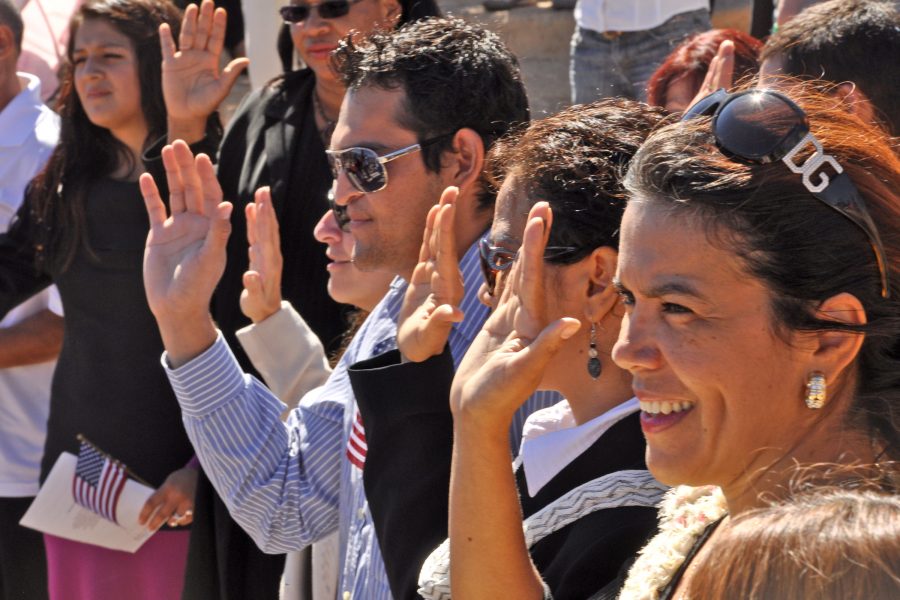
Becoming a U.S. citizen is a major milestone. Citizenship gives you the right to vote, travel with a U.S. passport, and enjoy stronger protection under U.S. law. It can also help you sponsor certain family members for immigration.
There are several legal ways to become a U.S. citizen. Some people are citizens automatically at birth. Others qualify through their parents. Many immigrants become citizens later through naturalization. This guide explains each path in simple terms so you can understand which one may apply to you.


4 Paths to Become a Citizen of the United States
In all, there are four fundamental ways to become a U.S. citizen: citizenship by birth in the U.S., birth abroad to citizen parent(s), through a parent who naturalizes after the child's birth, and as a permanent resident who naturalizes. Most immigrants in the United States become citizens through the naturalization process. In fact, nearly one million permanent residents apply for naturalization each year.
Citizenship through Birth in the United States
If you are born in the United States (including the territories of Puerto Rico, Guam, the U.S. Virgin Islands, and the Northern Mariana Islands) you automatically become a U.S. citizen at birth. Your parents’ immigration status usually does not matter. In most cases, even children of non-citizens are U.S. citizens if born on U.S. soil. There is an exception for children of parents who are foreign diplomats or members of a sovereign Native American tribe. The Fourteenth Amendment to the U.S. Constitution states that:
"All persons born or naturalized in the United States, and subject to the jurisdiction thereof, are citizens of the United States and of the State wherein they reside."
As most Americans are born on U.S. soil, this is clearly the post common of the ways to become a U.S. citizen. The next three paths address ways foreign nationals can obtain citizenship.
Birth Abroad to a Citizen Parent
Some people become U.S. citizens at birth even though they were born outside the United States. This is known as acquisition of citizenship.
In these cases, a child may automatically acquire U.S. citizenship at birth if one or both parents were U.S. citizens and met certain requirements before the child was born.
Basic Requirements
- Both parents were U.S. citizens Requires that both parents were U.S. citizens at the time of the child's birth and the parents were married at the time of birth abroad, and at least one parent lived in the U.S., or its territories, or both, prior to the child's birth.
- One parent was a U.S. citizen Requires that one parent was a U.S. citizen at the time of the child's birth abroad and the U.S. citizen parent was physically present in the U.S. or its territories for a certain number of years.
The exact rules depend on the child’s date of birth. U.S. citizenship laws have changed over time, so requirements are not the same for everyone. For more details on this path, review acquired citizenship →
Proving Citizenship
Typically, people who acquired citizenship at birth apply for a Certificate of Citizenship to document their status.

Automatic Citizenship Through a Parent’s Naturalization
Children who were not U.S. citizens at birth may still become citizens automatically when a parent naturalizes. This is commonly called derived citizenship.
This type of citizenship does not require the child to file a naturalization application, but specific conditions must be met.
Basic Requirements
A child under the age of 18 generally becomes a U.S. citizen automatically if:
- The child must have U.S. lawful permanent resident status ("green card" holder);
- At least one parent must be a U.S. citizen; and
- The child must be residing in the United States in the legal and physical custody of the U.S. citizen parent.
When all conditions are satisfied, citizenship happens automatically by law.
Proving Citizenship
A U.S. passport is valid proof of citizenship. However, many families also opt to request of Certificate of Citizenship as it offers advantages that a passport cannot. See the limitations of a U.S. passport →

Permanent Resident Who Naturalizes
For most immigrants, citizenship through naturalization is the primary way to become a U.S. citizen. This is a voluntary legal process that allows eligible permanent residents to apply for citizenship. Once naturalized, you have the same rights and responsibilities as someone who was a citizen at birth.
Basic Requirements
Most applicants apply through one of these three eligibility categories:
- 5 years as a permanent resident | General provision requirements →
- 3 years as a permanent resident who has lived in marital union with a U.S. citizen spouse for at least 3 years | Citizenship through marriage →
- Qualifying service in the U.S. Armed Forces | Citizenship through military service →
The vast majority of naturalized citizens come through one of the above paths, but you can find a comprehensive list of eligibility categories in Chapter 4 of USCIS Guide to Naturalization.
Proving Citizenship
After successfully naturalizing, new U.S. citizens receive a Certificate of Naturalization. This is proof of citizenship status and may be used to obtain a U.S. passport as well.

How to Figure Out Your Path to U.S. Citizenship
Think of this as a simple “yes or no” flow. Start at the top and follow the question that fits you best.
- Were you born in the United States? This includes the 50 states and certain U.S. territories.
- Yes → You are likely already a U.S. citizen by birth. You usually do not need to apply for citizenship, but you may want proof like a U.S. passport.
- No → Go to Question 2.
- Did you become a U.S. citizen through your parent(s)? Some people born outside the U.S. are already citizens because of their parents. Ask yourself:
- Was one or both of your parents a U.S. citizen?
- Did your U.S. citizen parent meet U.S. residence or physical-presence requirements?
- Were you under 18 when a parent naturalized and living with them in the U.S.?
If you’re not sure, use CitizenPath’s citizenship through parents overview to check your situation.- Yes, I qualify → You may already be a citizen and just need proof of citizenship (such as a Certificate of Citizenship or U.S. passport).
- No, I don’t qualify → Go to Question 3.
- Are you a lawful permanent resident (green card holder)? If you were not a citizen at birth or through your parents, this is the most common next step.
- Yes → You may be eligible to apply for naturalization (usually after 3 or 5 years as a green card holder).
- No → You must first obtain lawful permanent resident status before you can apply for U.S. citizenship.
Most Common Naturalization Eligibility Paths
| Eligibility Path | Who It Applies To |
|---|---|
| 5-Year Permanent Resident Rule | Most green card holders |
| 3-Year Marriage Rule | Permanent residents married to U.S. citizens |
| Military Service | Current or former members of the U.S. armed forces |
Review the citizenship requirements →
FAQs About Ways to Become a U.S. Citizen
How CitizenPath Gets You on the Path to Citizenship
CitizenPath provides simple, affordable, step-by-step guidance through USCIS immigration applications. Individuals, attorneys and non-profits use the service on desktop or mobile device to prepare immigration forms accurately, avoiding costly delays. CitizenPath allows users to try the service for free and provides a 100% money-back guarantee that USCIS will approve the application or petition. We provide support for the Naturalization Package (Form N-400), Citizenship Certificate Package (Form N-600), and several other immigration services.
Want more immigration tips and how-to information for your family?
Sign up for CitizenPath’s FREE immigration newsletter and
SAVE 10%
on our immigration services