
How the Visa Bulletin Works: Priority Dates, Charts, and Wait Times Explained
Most family-based immigrants cannot get a green card right away. U.S. immigration law limits the number of family-preference visas issued each year, which means demand almost always exceeds supply. When that happens, you wait — and the U.S. Department of State's monthly Visa Bulletin tells you exactly where you stand in that line.
This guide explains how the Visa Bulletin works, how to find your priority date, how to read the charts, and what to do when your date becomes current. If you'd rather skip straight to an estimate of your personal wait time, the tool below predicts it for you.

Key Takeaways
- The State Department publishes the Visa Bulletin monthly to show who can apply for a green card.
- Your priority date is the day USCIS received your I-130 — it marks your place in line.
- Two charts matter: Final Action Dates (visa available) and Dates for Filing (application allowed).
- China, India, Mexico, and Philippines nationals use a separate country column in each chart.
- Visa retrogression is normal — it doesn't change your priority date or your position in line.
What the Visa Bulletin Is and Why It Exists
Federal law limits the number of family-preference immigrant visas issued each fiscal year. Because demand for visas almost always exceeds that annual cap, most family members must wait. The U.S. Department of State issues visas on a first-come, first-served basis and publishes the Visa Bulletin every month to communicate which applicants may move forward.
The Visa Bulletin applies to family preference categories — not to immediate relatives of U.S. citizens. If you are the spouse, parent, or unmarried child under 21 of a U.S. citizen, visas are always available to you and the Visa Bulletin does not affect your case. Everyone else in a family preference category must monitor it.
The bulletin includes two charts for family-based cases:
- Final Action Dates — the chart that tells you when a visa is actually available to use
- Dates for Filing — the chart that tells you when you may submit your application, even if a visa isn't final yet
Each month, the Visa Bulletin publishes a cutoff date for each category and country. Your priority date is "current" when it falls before that cutoff. In plain terms: if the bulletin's cutoff date is ahead of yours on the calendar, a visa is available and you can move forward. If the cutoff date is behind yours, you are still waiting. Think of it like a deli counter — the bulletin announces which number is being served, and you're watching for yours to be called.
The Visa Bulletin can be confusing — and that's okay. Instead of decoding it yourself, use the free Green Card Wait Time Estimator. Enter your category, country, and priority date and it tells you where you stand.
How to Find Your Priority Date
Your priority date is your place in line. USCIS assigns it the day they receive the Form I-130 petition filed on your behalf. The earlier your priority date, the closer you are to the front of the line.
Finding your priority date is straightforward. Look at the I-797 Notice of Action that USCIS mailed after accepting the I-130 petition. It appears in the top section of the receipt notice and again on the approval notice once the petition is approved.
If you are not sure where your I-130 stands, you can check your USCIS case status online using your receipt number.
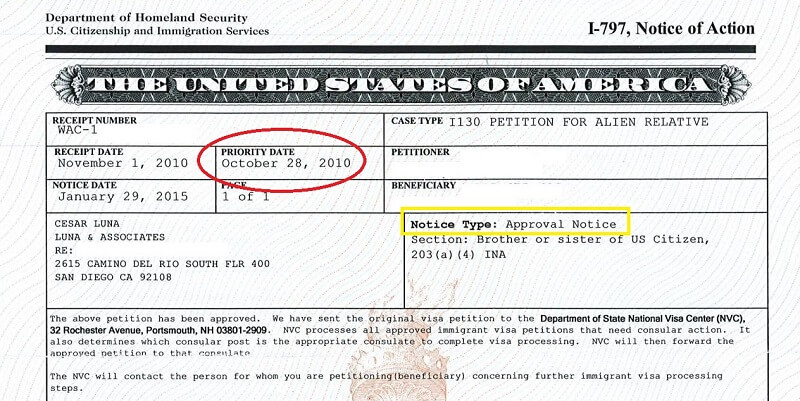
Keep your receipt notice and priority date somewhere safe. You will compare it to the Visa Bulletin every month until it becomes current.
Family Preference Categories Explained
Your family preference category depends on your relationship to the petitioner — the U.S. citizen or permanent resident who filed the I-130 for you. There are four family preference categories:
| Category | Who Qualifies | Petitioner |
|---|---|---|
| F1 | Unmarried sons and daughters, age 21 or older | U.S. citizen |
| F2A | Spouses and unmarried children under age 21 | Permanent resident (green card holder) |
| F2B | Unmarried sons and daughters, age 21 or older | Permanent resident (green card holder) |
| F3 | Married sons and daughters, any age | U.S. citizen |
| F4 | Brothers and sisters | Adult U.S. citizen (age 21 or older) |
If your relationship type isn't listed above, you may qualify as an immediate relative of a U.S. citizen. Immediate relatives — spouses, parents, and unmarried children under 21 of U.S. citizens — are not subject to annual caps, so the Visa Bulletin does not apply to them. They can proceed directly with their green card application.
How to Read the Visa Bulletin Charts
Once you know your priority date and your family preference category, go to the U.S. Department of State's Visa Bulletin page and open the current month's bulletin. Scroll to the "Family-Sponsored Preferences" section and locate the two charts.
Chart A: Final Action Dates
This chart shows the cutoff date for each category and country. Your visa is available if your priority date is earlier than the date shown in your category and country column. If the chart shows "C," that means the category is current — no wait applies.
Most applicants use the column labeled "All Chargeability Areas Except Those Listed." However, if you were born in China (mainland), India, Mexico, or the Philippines, use your country's column instead. Nationals of those four countries face longer waits because demand from those countries is especially high.
Sample Final Action Dates Chart
| Family-Sponsored | All Chargeability Areas Except Those Listed | CHINA-mainland born | INDIA | MEXICO | PHILIPPINES |
|---|---|---|---|---|---|
| F1 | 01DEC14 | 01DEC14 | 01DEC14 | 15NOV00 | 01MAR12 |
| F2A | C | C | C | C | C |
| F2B | 22SEP15 | 22SEP15 | 22SEP15 | 01JUN01 | 22OCT11 |
| F3 | 22NOV08 | 22NOV08 | 22NOV08 | 01NOV97 | 08JUN02 |
| F4 | 22MAR07 | 22MAR07 | 15SEP05 | 01AUG00 | 22AUG02 |
Chart B: Dates for Filing
This chart shows an earlier cutoff that allows you to file your application before a visa is fully available. If your priority date is earlier than the date shown here, you may submit your adjustment of status application to USCIS — but only in months when USCIS formally announces that this chart may be used. For consular processing cases, the National Visa Center uses this chart to begin document collection.
Sample Filing Dates Chart
| Family-Sponsored | All Chargeability Areas Except Those Listed | CHINA-mainland born | INDIA | MEXICO | PHILIPPINES |
|---|---|---|---|---|---|
| F1 | 08AUG16 | 08AUG16 | 08AUG16 | 01DEC02 | 22APR15 |
| F2A | C | C | C | C | C |
| F2B | 01JAN17 | 01JAN17 | 01JAN17 | 01JAN02 | 01OCT13 |
| F3 | 08NOV09 | 08NOV09 | 08NOV09 | 15JUN01 | 08NOV03 |
| F4 | 15DEC07 | 15DEC07 | 22FEB06 | 01APR01 | 22APR04 |
Use Data, Not Guesswork: Green Card Wait Time Estimator
Not everyone needs to read the Visa Bulletin line by line. The Green Card Wait Time Estimator is a shortcut that combines your priority date, family preference category, and country of chargeability with historical Visa Bulletin movement to give you a data-informed estimate of when you may be eligible to apply.
How the Visa Bulletin Works: Three Real Examples
These three examples show how the visa bulletin works in practice using the sample charts above.
Visa Retrogression and What It Means for Your Case
Visa retrogression happens when the Visa Bulletin's cutoff dates move backward instead of forward. A priority date that was current one month may suddenly no longer qualify the next. It sounds alarming, but it is a normal part of how the system works — not a sign that something went wrong with your case.
Retrogression usually occurs near the end of the fiscal year when annual visa caps are nearly exhausted. The State Department pulls dates back to prevent the cap from being exceeded. When the new fiscal year begins on October 1, a fresh supply of visas is released and cutoff dates typically recover.
What happens if retrogression affects your case:
- If you had already filed your adjustment of status application, your case remains pending and is generally not affected. USCIS processes your application once a visa becomes available again.
- If you had not yet filed, you must wait until your date becomes current again before submitting.
Retrogression does not reset your priority date. Your place in line stays the same.
What to Do When Your Priority Date Becomes Current
When the Visa Bulletin shows that your priority date is current, you are ready to take the next step toward a green card. The path forward depends on where you are located.
If you are inside the United States and entered lawfully, you may qualify for adjustment of status. This allows you to apply for a green card without leaving the country by filing your application package with USCIS. Common eligible groups include immediate relatives of U.S. citizens, K-1 fiancé visa holders who married their petitioner, asylees, refugees, and certain employer-sponsored workers.
If you are outside the United States, you will go through consular processing at a U.S. embassy or consulate. The National Visa Center (NVC) manages the pre-interview steps — collecting fees, documents such as Form I-864 Affidavit of Support, and scheduling your medical exam — before forwarding your case to the embassy for an interview.
One important deadline to remember: under Section 203(g) of the Immigration and Nationality Act, the State Department must terminate a petition if the beneficiary does not respond or apply within one year of the visa becoming available. The petition may be reinstated within two years, but only if the delay was beyond the applicant's control. Do not ignore NVC notices.
Start Your Application with Confidence
CitizenPath helps thousands of families prepare green card applications affordably and accurately. Our step-by-step software makes it easy to complete USCIS forms, avoid mistakes, and get approved quickly. You get real, human support when it matters.
Common Questions About How the Visa Bulletin Works
Affordable Immigration Support
What Customers Say About CitizenPath
Selected reviews from verified customers collected through Reviews.io and Trustpilot.