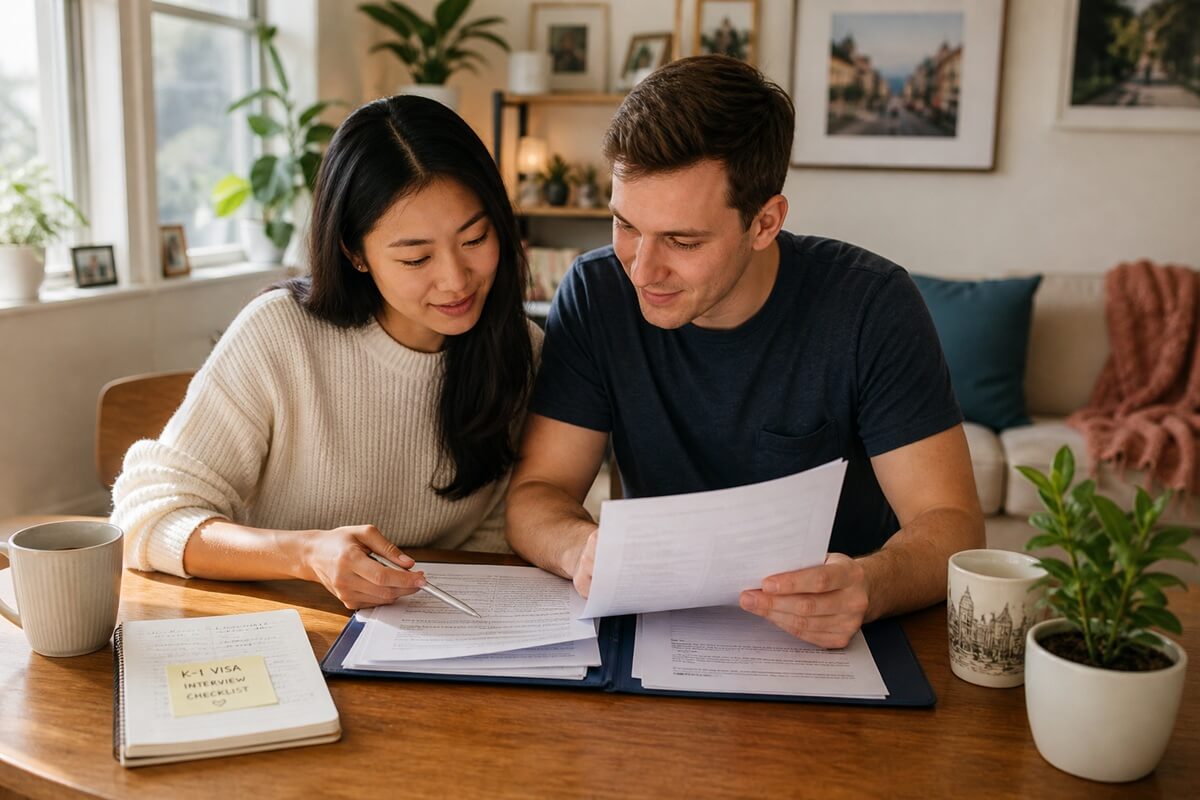
The K-1 visa interview is the final major step before your fiancé can travel to the United States. By the time the embassy schedules this appointment, USCIS has already approved your petition. Now a consular officer will confirm your identity, review your documents, and decide whether the relationship is genuine.
Most applicants who arrive organized and honest walk out with an approval the same day. The ones who run into trouble usually have missing documents, inconsistent answers, or weren't sure what to expect. This guide covers all three.

What Happens Before the Interview
The K-1 visa process starts long before the interview is scheduled. The U.S. citizen sponsor files Form I-129F, Petition for Alien Fiancé, with USCIS. After approval, USCIS forwards the case to the National Visa Center (NVC), which transfers it to the appropriate U.S. embassy or consulate abroad.
The NVC sends a letter notifying the couple when the case has been forwarded. At that point, the foreign national fiancé receives instructions to submit a visa application through the U.S. State Department's online system and to schedule the consular interview.
One important step happens before the interview itself: a medical examination. The U.S. Department of State requires all K-1 applicants to complete a medical exam with an authorized panel physician before the interview. The embassy or consulate will provide a list of approved physicians. The panel physician places results in a sealed envelope — bring it to the interview unopened. If the envelope has been opened, the results are invalidated and the exam must be repeated.
The State Department encourages K-1 applicants to complete the required immigrant visa vaccinations during this medical exam. The government does not require the vaccinations to grant the K-1 visa, but USCIS will require them later when the foreign spouse files for adjustment of status. Getting them done early avoids a second medical appointment later.
Who Attends the K-1 Visa Interview
The foreign national fiancé must attend the K-1 visa interview. Any K-2 children listed on the I-129F petition should also be present at the interview.
The U.S. citizen sponsor generally does not attend. This is the standard policy — the interview is designed to evaluate the foreign national's individual eligibility and knowledge of the relationship. Some embassies and consulates make exceptions, but this is not common. Check directly with the specific embassy handling the case before assuming the sponsor can attend.
K-1 Visa Interview Document Checklist
The U.S. Department of State publishes the required document list for the K-1 interview. Bring everything below, even items you don't expect to be asked about. If the consular officer needs a document that is unavailable, they may have to reschedule or delay the case — sometimes by weeks.
Organize documents in advance so you can produce any one of them quickly when asked.
| Document | What You Need to Know |
|---|---|
| DS-160 Confirmation Page | Complete the DS-160 K-1 visa application online at the State Department's CEAC website. Print the confirmation page and bring it to the interview. K-2 children must each have their own DS-160. |
| Valid Passport | Must be valid for at least six months beyond your intended period of stay in the U.S. Check the State Department's country-specific guidance — some countries have exemptions to this rule. |
| Birth Certificate | An original full-form birth certificate issued by the appropriate civil authority in your country. Short-form versions are generally not accepted. Documents in a language other than English (or the official language of the country where you're applying) must include a certified translation. |
| Form I-129F (Petition for Alien Fiancé) | A photocopy of the complete petition filed with USCIS, including all supporting documents originally submitted with it. |
| Form I-797 (Notice of Action) | A photocopy of the USCIS approval notice for the I-129F petition. This confirms USCIS has vetted and approved the petition. |
| Medical Examination Results | The sealed envelope from the authorized panel physician. Do not open it under any circumstances. Only a U.S. consular officer or CBP officer at the port of entry should open the packet. |
| Police Clearance Certificate | Required from your current country of residence and every country where you have lived for six months or more since age 16. K-2 children age 16 or older also need police certificates. See guidance on how to get a police clearance certificate. |
| Form I-134 (Declaration of Financial Support) | An original Form I-134 signed by the U.S. citizen petitioner in black ink. The State Department notes that Form I-134 income requirements use 100% of the federal poverty guideline — not the 125% threshold that applies to Form I-864 later. Bring supporting financial documents: the sponsor's most recent federal tax return, recent pay stubs, and employer verification if available. |
| Two Passport-Style Photos | 2"×2" color photos taken within 30 days of the interview. White or off-white background, glossy finish. Write your name and date of birth lightly in pencil on the back of each photo. Make sure photos meet the the full State Department photo requirements. |
| Divorce or Death Certificates (if applicable) | If either the fiancé or the U.S. citizen sponsor was previously married, bring original documents proving those marriages ended legally — a divorce decree, annulment, or death certificate. This applies to all prior marriages for both parties. |
| Evidence of Relationship | The consular officer will likely ask to see proof the relationship is genuine and ongoing. Although the petitioner submitted evidence of a geniune marriage with Form I-129F, use the opportunity to build on the evidence. Present additional recent photos together (if available), correspondence records, phone or video call logs, travel records showing visits, and any evidence of wedding planning. |
Review the specific instructions from the embassy or consulate handling your case. Some posts require additional documents — and requirements can vary by country.
What to Expect on the Day of the Interview
Understanding the logistics of the day reduces anxiety. Here is what typically happens.
Arrival and check-in. Plan to arrive early. Most applicants spend one to two hours at the embassy or consulate for security screening, document review, and biometric collection before the interview itself begins. Security is strict — bring only what you need.
The interview setting. The interview takes place at a window, typically with a glass partition between the applicant and the consular officer. The officer is a U.S. government employee, usually a Foreign Service officer trained in visa adjudication. Consular officers assigned to these posts often speak the local language and understand local culture.
Length. The interview itself is generally 15 to 20 minutes for a well-prepared applicant with complete documents. Cases with complicating factors or incomplete files take longer — and may require a follow-up appointment.
Rights and protections briefing. The U.S. Department of State requires consular officers to verbally summarize a Rights and Protections pamphlet during the K-1 interview. This covers the applicant's legal rights in the United States related to domestic violence, sexual assault, and child protection. Applicants are encouraged to read this pamphlet before the interview. The officer is also required to share any existing criminal background information on the U.S. citizen fiancé that USCIS received during the I-129F adjudication.
What the officer is evaluating. The consular officer is assessing two main things: whether the applicant is admissible to the United States, and whether the relationship with the U.S. citizen fiancé is genuine. Most questions will focus on the relationship — how the couple met, how they communicate, knowledge of each other's background, and concrete plans to marry within 90 days of arrival.
Preparing for the Interview Questions
The officer is not trying to trick applicants. The goal is to establish that the relationship is real. Consistent, honest, and detailed answers do that far more effectively than rehearsed ones.
The most important preparation you can do is review the I-129F petition and any other documents submitted to USCIS and the NVC. The officer may refer to information from those files. If your answers don't match what was submitted, it raises concerns — even if the discrepancy is minor.
Know your fiancé well: their full name and date of birth, where they live and work, their family background, how you communicate, when and how you got engaged, and your concrete plans for the wedding and where you'll live. These are the questions that come up most frequently.
For a full breakdown of the specific questions consular officers commonly ask — including how to approach each category and what raises red flags — see the complete fiancé visa interview questions guide →
Factors That Can Trigger Additional Scrutiny
Some circumstances prompt a consular officer to ask additional questions or request more evidence. This is not a denial — it is a closer look. Being prepared for it matters.
Common factors include:
- A significant age difference between the couple
- No common spoken language
- Very limited in-person time together before the interview
- A short engagement period after a brief acquaintance
- Large cultural or religious differences
- Prior K-1 petitions or marriage-based immigration by either party
None of these factors automatically disqualify a petition. But each one signals to the officer that the relationship needs closer verification. Strong relationship evidence — photos, travel records, correspondence, contact logs, and knowledge of each other's daily lives — is the most effective response to any of these circumstances.
If there is something in the applicant's background that is genuinely concerning — a prior visa overstay, criminal record, or previous immigration violation — that is a signal to consult an immigration attorney before the interview, not after.
Possible Outcomes After the Interview
There are three possible outcomes following a K-1 consular interview.
Approval. The officer approves the visa on the spot. The officer returns your passport with the K-1 visa inside, along with a sealed packet of documents. You must not open the packet — only a U.S. Customs and Border Protection officer at the port of entry should open it. The K-1 visa is valid for a single entry and must be used within six months of issuance.
Request for additional evidence. The officer cannot make a final decision without more documentation. This is not a denial. Submit whatever is requested as quickly as possible. Delays in responding extend the timeline.
Denial. The application is denied. This is uncommon in cases with a genuine relationship and complete documentation. The officer will explain whether a waiver is available. If denied, speaking with an immigration attorney is strongly recommended before taking any next steps.
Once the embassy or consulate issues the K-1 visa, the foreign national must enter the United States and marry the U.S. citizen sponsor within 90 days of arrival. After the marriage, the foreign spouse can begin the process of adjustment of status through a K-1 entry to apply for a green card.
Frequently Asked Questions About the K-1 Visa Interview
Ready for the next step? After the K-1 visa approval and you've married your U.S. citizen fiancé, the path to a green card runs through adjustment of status. CitizenPath makes it easy to prepare the required forms accurately — with step-by-step guidance, automatic error checks, and attorney-reviewed instructions. Start your Adjustment of Status Package today →
Want more immigration tips and how-to information for your family?
Sign up for CitizenPath’s FREE immigration newsletter and
SAVE 10%
on our immigration services