
Individuals who apply for an immigrant visa (green card) or K-1 fiancé visa from outside of the United States must submit a police clearance certificate. It’s a standard part of the process, but the process can be a little confusing for applicants. This article provides an overview of the purpose for a police certificate, where to obtain one, and how to make sure everything is correctly submitted.


Police Clearance Certificate, Defined
A police clearance certificate — sometimes called a police certificate — is a government-issued document that records any arrests and their outcomes for a person who lived in a particular country. Think of it as a formal background check document issued by a foreign government on your behalf.
If you are applying for a family based green card through consular processing or a K-1 fiancé visa, you must submit a police clearance certificate from every country where you have lived. This requirement also applies to any children who are 16 years of age or older.
Even if you have never been arrested, you must still submit the certificate. A clean record must be documented — it cannot simply be assumed.
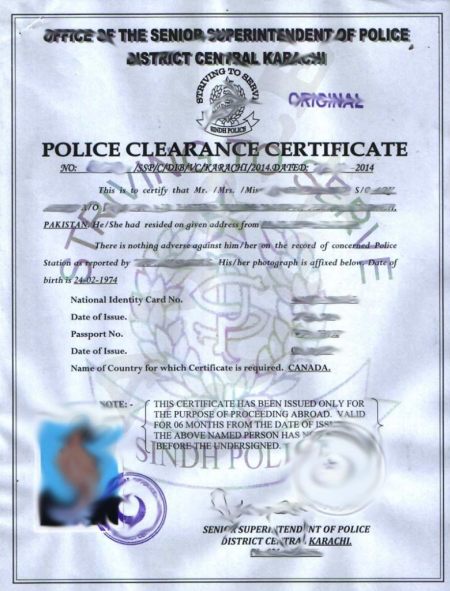
The U.S. Department of State uses the police certificate as part of the background check it conducts before issuing an immigrant visa or K-1 visa.
Police Certificate Requirements
The requirement applies to any applicant who is at least 16 years old and is going through consular processing abroad. The U.S. Department of State requires you to submit a certificate from each of the following, with one exception for the United States:
- Your country of nationality, if you lived there for at least six months at any point in your life
- Your country of current residence, if it differs from your country of nationality and you have lived there for at least six months
- Any other country where you lived for at least 12 months and were at least 16 years old at the time
- Any country or region — other than the United States — where you were arrested for any reason, regardless of how long you lived there
The certificate must cover the entire period of your residence in that country, be issued by the appropriate police authority, and include all arrests, the reason for each arrest, and the final outcome of each case.
When to Request Your Certificate
Timing matters. Police clearance certificates have a limited validity period, so you should not request them too early.
After USCIS approves your petition — whether that is Form I-130 for a family-based immigrant visa or Form I-129F for a K-1 visa — the case transfers to the National Visa Center. The National Visa Center will then contact the petitioner and beneficiary, typically within 4–8 weeks, to request supporting documents. That is the right moment to begin gathering your police certificates.
The U.S. Department of State considers each police certificate valid for two years from the date it was issued. The certificate must remain valid through your visa interview date.
If your visa interview is scheduled more than two years after your certificate was issued, the State Department requires a new one — but only when all of these conditions apply at the time of your interview:
- The certificate is more than two years old
- You continue to live in, or have returned to, the country that issued the certificate
- You are at least 16 years of age

How to Get a Police Clearance Certificate
The process varies by country, but the U.S. Department of State makes it straightforward to find the right issuing authority.
Determine which countries are required
Review the requirements above. You will need at least one certificate, and possibly more if you have lived in multiple countries or were arrested abroad.
Find the issuing authority for each country
The State Department maintains a Reciprocity and Civil Documents by Country page. To find the right authority:
- Go to the State Department's Reciprocity page
- Select your country from the list
- Click the "Police, Court, Prison Records" tab
- Follow the country-specific instructions for requesting your certificate
For most countries, you can expect a response within two to eight weeks, though timelines vary.
Handle cases where a certificate is unavailable
In rare situations, a country does not issue police clearance certificates or cannot provide one. Unless the State Department's reciprocity page explicitly states that records are "unavailable" for that country, you must provide evidence of your attempts to obtain it. Specifically, submit:
- A notarized, sworn written statement explaining in detail why you could not obtain the certificate
- Documentation showing your attempts to request the certificate from that country's government
If you cannot obtain a certificate — particularly if you have an arrest record in that country — consult an immigration attorney before proceeding.
Submit a copy, not the original
Submit a photocopy of your police clearance certificate to the National Visa Center. Do not send the original. Most applicants scan and upload documents electronically through the NVC's online portal. Keep the original in a safe place and bring it to your consular interview.
If your police clearance certificate is not written in English — or in the official language of the country where you are applying — the U.S. Department of State requires you to submit a certified translation alongside the original.
Applicants with an Arrest Record
A criminal record does not automatically disqualify you from receiving an immigrant visa or K-1 visa. However, the U.S. Department of State will review the record carefully. USCIS and the State Department evaluate certain criminal convictions under the grounds of inadmissibility provisions of the Immigration and Nationality Act.
If you have an arrest record, be honest and thorough. Omitting or misrepresenting information is far more damaging to your case than the arrest itself. If you are concerned about how your record may affect your application, speak with a qualified immigration attorney before your interview.
Adjustment of Status Applicants: Different Rules Apply
If you are filing Form I-485 to adjust status to permanent resident from inside the United States, you generally do not need to submit foreign police clearance certificates. Instead, USCIS requires certified police and court records.
At the time you file Form I-485, you must generally submit to USCIS certified police and court records for each arrest or criminal charge — even if the incident happened when you were a minor, and even if the arrest was later expunged from your record.
You are not required to report or provide documentation for minor traffic violations that did not result in criminal charges and did not involve alcohol, drugs, personal injury, or property damage.
For a full overview of what documents to gather, see our guide to civil records for immigration. To compare your two main paths, our guide on adjustment of status vs consular processing can help you decide which route makes sense for your situation.
Frequently Asked Questions About Police Clearance Certificates
File Your Immigration Forms with Confidence
CitizenPath makes it easy to prepare USCIS immigration forms accurately — without an attorney's price tag. Our step-by-step guidance walks you through each question, flags common mistakes before they cause delays, and backs every application with a 100% money-back guarantee. Thousands of families have used CitizenPath to prepare their green card, fiancé visa, and citizenship applications with confidence.
Want more immigration tips and how-to information for your family?
Sign up for CitizenPath’s FREE immigration newsletter and
SAVE 10%
on our immigration services