
The United States has long offered economic opportunity. Immigrants have contributed to agriculture, manufacturing, and the largest U.S. businesses. Today there are many types of work visas and immigration statuses that allow employment, but the rules vary by type. This guide covers some of the more popular U.S. work visas.


What You'll Learn
- Immigrant Visas (Permanent Employment-Based Immigration)
- EB-1: Priority Workers
- EB-2: Professionals with Advanced Degrees or Exceptional Ability
- EB-3: Skilled Workers, Professionals, and Unskilled Workers
- Nonimmigrant Work Visas (Temporary Employment-Based Visas)
- E-1/E-2 Visa: Treaty Trader or Treaty Investor
- H-1B Visa: Professional Workers in a Specialty Occupation
- L-1 Visa: Temporary Intra/Intercompany Transferee
- O-1 Visa: Aliens of Extraordinary Ability
- TN Visa: NAFTA TN Professional
- Nonimmigrant Employment Authorization (Temporary & Not Employment-Based)
Immigrant Visas (Permanent Employment-Based Immigration)
An immigrant visa (often called a green card) allows you to become a permanent resident. As a permanent resident you face few work‐restrictions. You can generally work for any employer and switch jobs as you wish (except for roles reserved only for U.S. citizens). The green card itself is proof of employment authorization.
Every immigrant visa includes the right to work. So a green card gives you wide employment options. Some green cards are employment-based, meaning your job makes you eligible. Most of them require an employer to sponsor you. Employment-based categories include:
EB-1: Priority Workers
The EB-1 (first preference) category is for priority workers. It includes three subgroups: EB-1A (extraordinary ability), EB-1B (outstanding professors/researchers), and EB-1C (multinational executives/managers). Usually a U.S. employer must offer you a permanent job and file a petition. But if you qualify under EB-1A for extraordinary ability, you may self-sponsor. U.S. law caps about 40,000 EB-1 visas each year—plus country-specific limits.
EB-2: Professionals with Advanced Degrees or Exceptional Ability
The EB-2 (second preference) category suits professionals with an advanced degree or foreign nationals with exceptional ability in arts, science, or business. Usually you must have a certified labor certification from the Department of Labor. But you may qualify for a National Interest Waiver if you have exceptional ability and your U.S. employment would benefit the nation.
EB-3: Skilled Workers, Professionals, and Unskilled Workers
The EB-3 (third preference) category covers:
- Skilled workers (at least two years of training or experience)
- Professionals (with college degrees)
- “Other” workers (unskilled labor that is neither temporary nor seasonal)
While the EB-3 visa does have a less stringent set of requirements, there is also a longer backlog. There is high demand for this type of work visa. Most EB-3 and many EB-2 cases need employer sponsorship and a PERM labor certification. PERM confirms that no sufficient U.S. workers are available for the job and that hiring a foreign national won’t hurt wages or working conditions. In most cases the employer must get a certified labor-application from the DOL before filing the petition with U.S. Citizenship and Immigration Services (USCIS).

Nonimmigrant Work Visas (Temporary Employment-Based Visas)
U.S. law also accommodates a variety of nonimmigrant visas designed for employment purposes. These U.S. work visas grant temporary work authorization and are not connected to permanent residency. There are typically several restrictions put on type of employment, specific employers and the length of time one can be employed. Proof of employment authorization is generally the visa.
Nonimmigrant U.S. work visas are visas that grant a foreign national the right to temporarily visit the United States. A foreign national who enters the U.S. in nonimmigrant status is restricted to the activity or reason for which they were allowed entry. And once that purpose has been completed or the authorized stay expires (which comes first), the foreign national must depart the United States. For example, a B-2 visitor is authorized to visit for pleasure. The law does not authorize a B-2 visitor to enroll in a university and become a student. An F-1 student visa (and a few other types of visas) are for this purpose. The same goes for these employment visas:
E-1/E-2 Visa: Treaty Trader or Treaty Investor
The E-1 visa lets nationals of treaty countries engage in international trade in the U.S. The E-2 visa lets you qualify as a treaty investor. You must be a national of a country with a trade treaty with the U.S. You must also show you’re coming under that treaty to carry on substantial trade. For E-2, your investment must be substantial and in a real operating business with significant U.S. economic impact. A large passive bank account investment will not qualify.
H-1B Visa: Professional Workers in a Specialty Occupation
The H-1B visa is in high demand. You must have a job offer from a U.S. employer in a specialty occupation—typically requiring a bachelor’s degree or higher. Your employer must sponsor you by filing Form I-129 and a labor condition application with USCIS. H-1Bs are employer-specific and don’t easily transfer. Only a limited number are issued each year. Many employers use immigration law firms to manage this process. Once approved, you can extend your visa for up to six years.
L-1 Visa: Temporary Intra/Intercompany Transferee
Large companies often use the L-1 visa to transfer executives, managers, or employees with specialized knowledge from a foreign branch into the U.S. The L-1 holder may be transferred temporarily or may help establish a U.S. presence. You must have worked for the foreign employer continuously for one year within the past three years. L-1 visas split into L-1A (managers/executives) and L-1B (specialized knowledge). Non-profits, religious and charitable organizations can also use L-1. Firms that regularly use L-1 employees can file a “blanket” petition to streamline transfers. The initial stay is three years and can be extended up to seven years.
O-1 Visa: Aliens of Extraordinary Ability
The O-1 visa lets U.S. employers hire foreign nationals with extraordinary ability. O-1A covers science, education, business and athletics. O-1B covers the arts or extraordinary achievement in film or television. You may stay initially for up to three years and can extend in one-year increments.
TN Visa: NAFTA TN Professional
The TN visa was established under the North American Free Trade Agreement (NAFTA). It is available to eligible Canadian and Mexican nationals who work for a U.S. employer. Only certain professions qualify, such as accountants, architects, engineers, designers, lawyers, pharmacists, scientists and teachers. Applicants generally must have a bachelor’s degree or higher. TN status is granted initially for three years and may be extended for another three.

Nonimmigrant Employment Authorization (Temporary & Not Employment-Based)
In addition to temporary visas set up specifically for employment purposes, there are some nonimmigrant visa holders and other immigration statuses that may be eligible for employment authorization. Individuals that fall into these eligibility categories must apply for the work authorization using Form I-765.
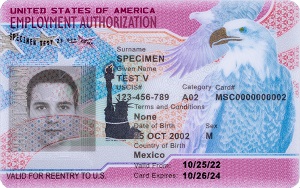
Upon approval, USCIS grants an Employment Authorization Document (as pictured above). Commonly referred to as an EAD or work permit, this document is proof of employment authorization.
It is illegal for U.S. businesses to knowingly employ someone whose employment authorization has expired. Companies that violate the law could face civil fines or their executives could go to jail in extreme cases.

If you’d like to learn more about U.S. work visa types and find out which option is right for you, visit the USCIS website or speak with an immigration attorney for personalized guidance. You can also explore CitizenPath’s resources for easy-to-understand information and step-by-step help with preparing the Application for Employment Authorization (Form I-765).
About CitizenPath
CitizenPath provides simple, affordable, step-by-step guidance through USCIS immigration applications. Individuals, attorneys and non-profits use the service on desktop or mobile device to prepare immigration forms accurately, avoiding costly delays. CitizenPath allows users to try the service for free and provides a 100% money-back guarantee that USCIS will approve the application or petition. We provide support for the Employment Authorization Package (Form I-765) and several other immigration forms.
Want more immigration tips and how-to information for your family?
Sign up for CitizenPath’s FREE immigration newsletter and
SAVE 10%
on our immigration services