
USCIS Request for Evidence (RFE): What It Is and How to Avoid One
A Request for Evidence (RFE) is one of the most stressful things USCIS can send you. It stops your case in its tracks, adds months to your wait, and puts the outcome of your application in jeopardy. The good news is that most RFEs are preventable. Understanding what triggers them — and how to file a complete application from the start — is the best way to protect your case.

Key Takeaways
- A USCIS Request for Evidence pauses your case and can delay processing by months.
- An RFE is not a denial — but a late or incomplete response usually leads to one.
- Most RFEs result from missing documents or incomplete evidence, not eligibility problems.
- You get one chance to respond to an RFE, so your response must be complete.
- Filing a thorough application from the start is the best way to avoid an RFE.
What Is a Request for Evidence?
U.S. Citizenship and Immigration Services (USCIS) issues a Request for Evidence when the officer reviewing your application cannot make a decision based on what you submitted. It means something is missing, unclear, or insufficient. USCIS will send the notice by mail on Form I-797E.
Receiving an RFE does not mean your application is denied. It means your case is still active, and USCIS is giving you an opportunity to fill in the gaps. However, that opportunity comes with a deadline — and a single chance to get your response right.
Once USCIS issues an RFE, processing stops completely. Your case sits idle until you respond. That pause can add several months to an already long wait. And if your response is incomplete or late, USCIS will deny your application based on the existing record.
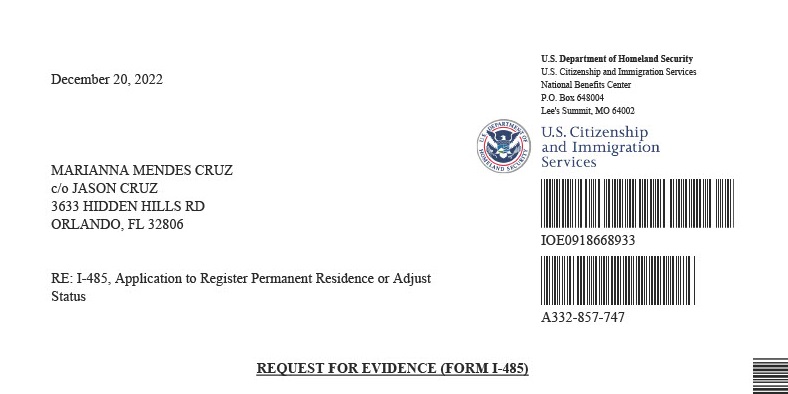
Why USCIS Issues a Request for Evidence
USCIS issues RFEs across virtually every immigration benefit category. While the specific triggers vary by form type, many family-based issues fall into a handful of recurring patterns. Filing a thorough, well-organized application is the most effective way to avoid them.
Missing or Incomplete Documentation
The most common reason for an RFE is a simple one: something was left out. USCIS requires specific initial evidence for each form, and missing even one required item can pause your entire case. Review USCIS instructions carefully to ensure you've included all necessary evidence. Or, if you use CitizenPath, you'll always get a checklist of supporting documents customized for your situation.
Insufficient Financial Support
Family-based green card applications require the sponsor to prove they meet income requirements. Sponsors must document income and assets on Form I-864, Affidavit of Support, and failure to include the right supporting documents is a frequent RFE trigger. Incomplete tax returns, missing pay stubs, or misunderstanding the public charge rule can all create problems. See how its the most common reason for an I-485 RFE →
Missing Proof of Lawful Entry
For adjustment of status applicants, USCIS needs proof that you entered the United States lawfully. In most cases, a copy of your Form I-94, Arrival/Departure Record, satisfies this requirement. If you cannot locate it, you can obtain a replacement online before filing. Without evidence of a lawful entry, your application is likely to stall.
Insufficient Proof of a Bona Fide Relationship
For marriage-based petitions and removal of conditions, USCIS needs to see that your relationship is real. This means joint financial records, shared lease or mortgage documents, photos, correspondence, and other evidence of a shared life. A thin evidence package is one of the most common triggers for a bona fide marriage RFE. Don't underestimate the documentation needed to evidence a bona fide marriage with Form I-130 and be thorough when building your I-751 evidence list.
Missing Certified Translations
Any document submitted in a foreign language must include a full English translation. USCIS requires that the translator certify their competency to translate and attest to the accuracy of the translation. Missing or incomplete certified translation will trigger an RFE, even when the underlying document itself is complete and valid.
Insufficient Proof of Identity or Birth
USCIS has specific requirements for birth certificates. Long-form birth certificates are generally required, and some countries issue documents that do not meet USCIS standards. When adequate civil records do not exist, secondary evidence may be required. A birth certificate for a green card must satisfy USCIS expectations — alternatives exist, but they require documentation of why the primary record is unavailable.
Why an RFE Is a Problem Worth Avoiding
An RFE is not the end of your case, but it is a serious setback. Here is what one actually means for your timeline and your outcome.
It stops your case cold. Processing halts the moment USCIS issues an RFE. You will not receive any updates on your case until after you respond and USCIS resumes review. The total delay — from the RFE issuance through the response period and back into the adjudication queue — routinely adds three to five months to your wait, sometimes more.
It creates a high-stakes, one-shot situation. USCIS generally issues only one RFE per application. You get a single opportunity to respond with everything the officer needs. If your response is incomplete, USCIS will deny your application. Rarely is there a second chance to fix it.
A denial carries real consequences. If USCIS denies your application, you may need to refile — paying fees again, restarting processing times, and in some cases, addressing changed circumstances that affect your eligibility. An adjustment of status denial is far more difficult to recover from than a preventable RFE.
Most RFEs are avoidable. The majority of RFEs are triggered by missing documents, incomplete evidence, or filing errors — not by fundamental eligibility problems. A careful, complete initial filing eliminates most of the risk. That is where the real work happens.
Affordable Immigration Support
How to Respond to a Request for Evidence
If you have already received an RFE, respond carefully and on time. Here is what that looks like in practice.
Read the notice thoroughly. USCIS will identify the specific evidence or documentation it needs. The language can be vague or scripted, so read it carefully. Understand exactly what the officer is asking for before you gather anything.
Respond once, completely. USCIS expects a single, comprehensive response. Do not send documents in batches. Anything not included in your response will not be considered, even if you send it before the deadline. Address every item in the RFE in one organized package.
Organize your response clearly. Place the original RFE notice on top. Follow it with a cover letter that lists each item you are submitting. A cover letter is not required, but it helps the officer confirm that you have addressed every request. Label exhibits clearly. You may use this RFE cover letter example as a starting point.
Meet the deadline. USCIS typically allows between 30 and 87 days to respond. The deadline is printed on the notice. Late responses are not accepted. Mail your package using a trackable service — USPS Priority Mail, FedEx, UPS, or DHL — and keep the delivery confirmation for your records.
If the RFE is complex or you are unsure how to address the specific requests, consult an immigration attorney. You can find an immigration attorney through CitizenPath's referral resource.
How CitizenPath Helps You Avoid an RFE
CitizenPath is built around preventing the kind of filing errors that trigger RFEs in the first place. Our service was designed by immigration attorneys to walk you through each form step by step, flag potential problems before you file, and make sure your supporting documents are complete. With more than a decade of service helping thousands of applicants, we know where to problem spots usually are.
Here is what that looks like in practice:
- Personalized filing instructions tailored to your specific situation, including a checklist of the supporting documents USCIS will expect.
- Instant alerts when something in your application looks incomplete, inconsistent, or potentially problematic.
- Attorney-reviewed guidance that reflects current USCIS requirements — not generic advice.
- A money-back guarantee that your form will be approved, backed by live customer support if you have questions along the way.
CitizenPath cannot fix an RFE after the fact. But we can help you file correctly from the start — which is the only reliable way to keep your case moving without interruption. Our online immigration services cover the most common family-based immigration forms, including adjustment of status, green card renewal, and more. View our affordable immigration packages →
Affordable Immigration Support
RFIEs and NOIDs Are Different
Two other USCIS notices are sometimes confused with a standard RFE.
A Request for Initial Evidence (RFIE) is issued when your application is missing something basic that should have been included from the start — a missing signature, a required form, or a filing fee. RFIEs are relatively rare because USCIS typically rejects incomplete packages outright. If you receive one, respond by the deadline with the requested materials. Failure to do so almost always results in denial.
A Notice of Intent to Deny (NOID) is a different matter entirely. A NOID means a USCIS officer has reviewed your case and is planning to deny it. It is a serious, time-sensitive notice that typically requires more than additional documentation — it requires a strong legal argument. If you receive a NOID, seek help from an immigration attorney as quickly as possible. Learn more about a Notice of Intent to Deny →
Request for Evidence FAQs
What Customers Say About CitizenPath
Selected reviews from verified customers collected through Reviews.io and Trustpilot.