
Form I-94 Explained: How to Find, Read, and Fix Your Record
Form I-94, Arrival/Departure Record, is the official document that tracks your authorized stay in the United States. This guide explains what Form I-94 is, how to find your record online, how to read the key fields — including your all-important Admit Until Date — and what to do if your record is missing, incorrect, or needs to be replaced.

What Is Form I-94?
Form I-94, Arrival/Departure Record, is the official document that defines the terms of a foreign national's stay in the United States. It shows your admission category, the date by which you must depart, and serves as proof of lawful entry into the country.
U.S. Customs and Border Protection (CBP) issues Form I-94 to most foreign nationals when they enter the U.S. USCIS may also issue an I-94 when approving an extension of stay or a change of status.
CBP does not issue an I-94 to:
- U.S. citizens
- Permanent residents (green card holders)
- Returning residents (SB-1 visa holders)
- Most Canadian visitors and transit travelers
You should review your I-94 carefully when you enter the United States, apply to adjust status, or request an extension of stay.
What is Form I-94W? Foreign nationals entering through the Visa Waiver Program receive Form I-94W (Nonimmigrant Visa Waiver Arrival/Departure Record) instead of the standard I-94.
How to Find Your Form I-94
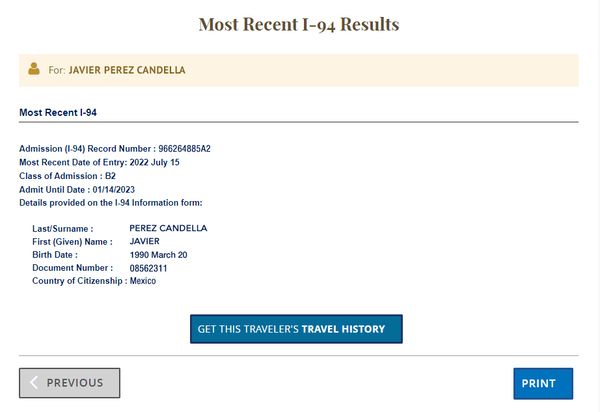
Most people can retrieve their arrival/departure record online through CBP's I-94 website. CBP automatically creates your electronic I-94 when you arrive at an air or sea port of entry — there's nothing to request. You simply go to the CBP website to retrieve and print it.
If you entered through a land border crossing, CBP generally issues a paper Form I-94 instead.
Electronic I-94
Since May 2013, CBP has automatically issued an electronic Form I-94 to travelers arriving at air and sea ports. The record is not sent to you directly — you must retrieve it yourself from CBP's I-94 website. From there, you can print a copy for your records.
The site also provides a travel history showing your arrivals and departures over the past 10 years. That history is an informational tool only — it is not an official record for legal purposes.
Paper I-94
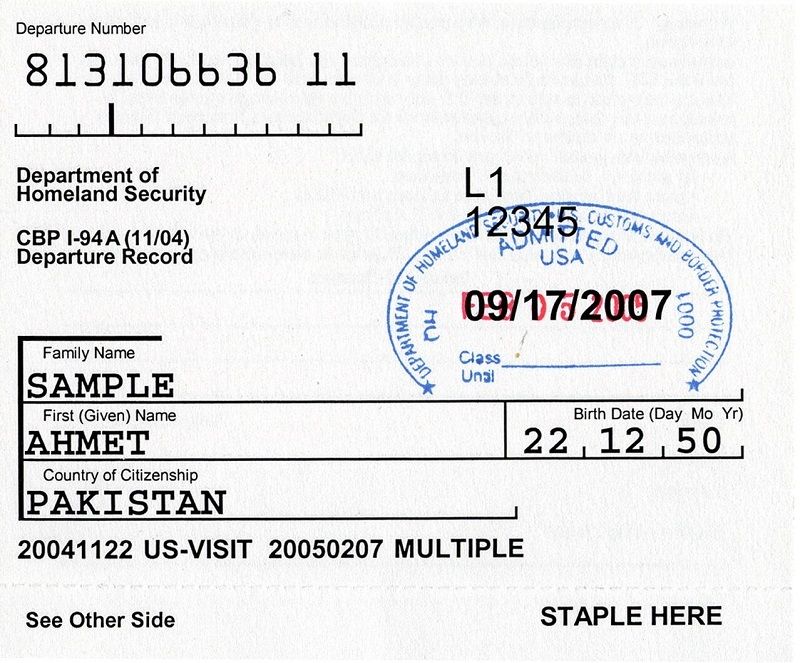
Before May 2013, CBP issued paper I-94 records to all foreign visitors. CBP continues to issue paper forms in certain situations, including:
- Entry at a land border port of entry
- Refugees, certain asylees, and parolees
- Other situations where CBP determines a paper form is appropriate
The paper version is labeled Form I-94A.
Applying in advance: If you are arriving at a land border, you can apply for a provisional I-94 online up to seven days before your arrival. You will pay a $30 fee when submitting your application. Doing this in advance can reduce your wait time at the border.
How to Read Your Arrival/Departure Record
Your I-94 contains several important fields. Knowing what each one means helps you stay in status and correctly complete immigration applications. On the CBP website, you can print a copy similar to the sample shown below.
Here are the key fields:
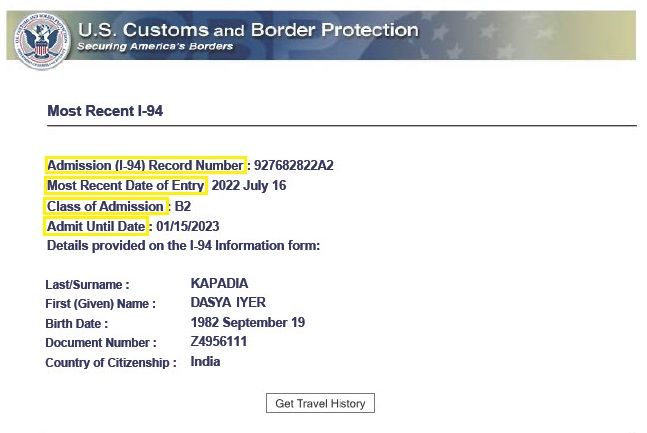
Admission (I-94) Record Number: Also called the I-94 Number, Departure Number, or Admission Record Number. It is an 11-character alphanumeric number that identifies your specific entry. Many USCIS forms ask for this number.
Most Recent Date of Entry: The date you were admitted to the United States. This may differ slightly from the date you physically arrived if your inspection occurred outside the U.S.
Class of Admission: A code that describes your nonimmigrant status category. For example, B-2 indicates a leisure visitor; F-1 indicates a student.
Admit Until Date: This is the most critical field. It is the date your immigration status expires. You must exit the U.S. on or before this date. For students and certain exchange visitors, this field will show "D/S" (Duration of Status) rather than a specific date. For most other visa categories, it will be a hard deadline.
I-94 Troubleshooting
If you are having trouble finding your electronic I-94 record on CBP's I-94 website, the American Immigration Lawyers Association recommends the following steps.
Try these name variations:
- Enter your name exactly as it appears on your passport. If that doesn't work, try the name as shown on your visa or Form DS-160.
- Enter your first and middle name together in the First Name field, with a space between them — even if the middle name doesn't appear on your passport.
- Try switching the order of your first and last name. Some countries list names in a different order, which can cause a mismatch in CBP's system.
- If you have two first names or two last names, enter them without a space between them (for example, "Mary Jane" as "Maryjane")
Try these passport number variations:
- Check your Form DS-160 for the passport number used at the time of your visa application. If it differs from your current passport, try that number.
- Compare the passport number on your visa to your current passport. If they differ, try the number on the visa.
- If your passport number includes a year prefix (common with some Mexican passports), try entering the number without it.
Try these visa classification variations:
- Check both your visa and your passport admission stamp. The classification may be written slightly differently on each. Try both versions. For example, a visa may show "E-3D" while the stamp shows only "E-3."
If none of these steps resolve the problem, contact or visit a CBP Deferred Inspection Office. You can explain your situation by phone — some offices can resolve the issue without an in-person visit. Others may require you to come in with your passport and flight information. In some cases, travelers were simply never issued a record, and CBP can correct that.
Affordable Immigration Support
Fixing an Incorrect Form I-94
Both CBP and USCIS can issue a Form I-94, so which agency you contact to fix an error depends on which agency issued your record.
Correct a CBP-Issued I-94
Most foreign nationals receive their I-94 from CBP at the time of entry — either electronically at air and sea ports, or on paper at land border crossings.
Common errors include incorrect entry dates or misspelled names. If you arrived at an airport, you can often contact the CBP office inside the airport to request a correction on the spot.
If the airport does not have a CBP office, contact the nearest CBP Deferred Inspection Site or call CBP at 1-877-227-5511. You may need to bring your passport, visa, and the incorrect I-94 record.
Correct a USCIS-Issued I-94
USCIS sometimes issues a Form I-94 when granting an extension of stay or change of status. If USCIS issued your record, you must file Form I-102, Application for Replacement/Initial Nonimmigrant Arrival-Departure Document to correct it.
When filing due to an error, include a filing fee, a signed and dated statement explaining what information is incorrect, and supporting evidence showing the correct information. You must also submit your original, incorrect I-94 with the application.
If USCIS made the error, call them at 1-800-375-5283 to request an in-person appointment at your local USCIS office. Bring your incorrect I-94 and documentation proving the mistake. USCIS will correct it at no cost. If you cannot prove USCIS made the error, you will need to file Form I-102 with the applicable fee.
Replacing a Lost or Destroyed I-94
If your Form I-94 is lost, stolen, mutilated, or destroyed, you can replace it. The process depends on whether you have an electronic or paper I-94.
Replace an Electronic I-94
If you entered by air or sea, your I-94 is electronic and easy to retrieve. Go to the CBP I-94 website, enter your information, and print a new copy. There is no fee to do this, and you can repeat it as many times as needed.
Replace a Paper I-94
If you have a paper-based I-94 (Form I-94A) — which is issued at land border crossings and to certain classes of foreign nationals including refugees, asylees, and parolees — replacing it requires filing Form I-102, Application for Replacement/Initial Nonimmigrant Arrival-Departure Document with USCIS. If you were previously issued a Form I-94, there is generally no filing fee to replace it. Confirm the current fee on the USCIS website before submitting.
Affordable Immigration Support
Frequently Asked Questions About Form I-94
What Customers Say About CitizenPath
Selected reviews from verified customers collected through Reviews.io and Trustpilot.