A USCIS form is asking for your alien registration number, and you are not sure which number on your documents is the right one. Plenty of people get stuck here before they even start the application.
Your alien registration number, often called an A-Number, appears on most immigration documents. The catch is that each document labels it differently. This guide shows you where to look on each one, what to do when your number is shorter than the form expects, and how to tell whether you have one at all.


What You'll Learn
- Where your A-Number appears on six common immigration documents
- Why the USCIS# on your card is your A-Number
- How to write a short A-Number correctly on USCIS forms
- What an A-Number identifies and why it never changes
- How to tell whether you have been assigned one yet
- Five places to look when you cannot find your number
Where to Find Your A-Number on Each Immigration Document
Your A-Number appears on at least six different documents that immigrants commonly hold. Find the one you have below, then look in the place described.
Green Card (Permanent Resident Card)
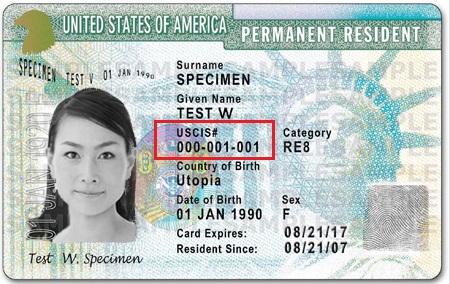
Your A-Number appears on the front of your green card, labeled USCIS#. It is also encoded in the characters printed on the back of the card. On the sample card, the number reads 000-001-001 directly beneath the USCIS# label.
Employment Authorization Document (Work Permit)
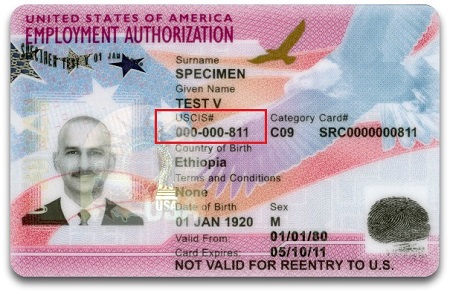
Your A-Number appears on the front of your Employment Authorization Document, also labeled USCIS#. On the sample card, the number reads 000-000-811. If you hold an employment authorization document but no green card, this is usually the easiest place to find your number.
Immigrant Visa in Your Passport
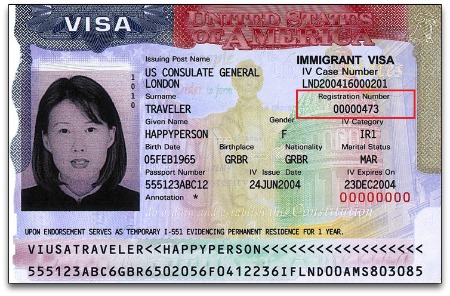
Your A-Number appears on an immigrant visa as the Registration Number, in the upper right portion of the visa page. Many people call an immigrant visa a visa stamp or visa foil. It sits inside your passport.
A nonimmigrant visa does not contain an A-Number. Tourist, student, and temporary work visas fall into that category.
Form I-797 Notice of Action
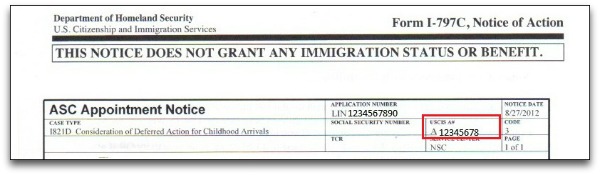
Some versions of Form I-797 display your A-Number in the upper right of the notice, next to the USCIS# label. The I-797C biometrics appointment notice is one of the versions that shows it.
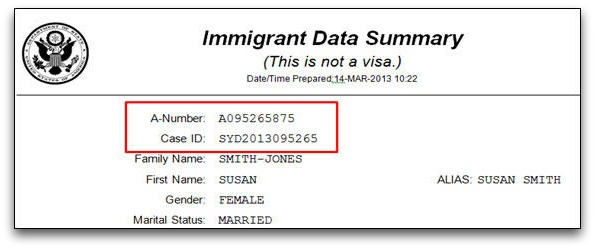
Immigrant Data Summary
Your A-Number appears at the top of the Immigrant Data Summary. If you obtained your green card through consular processing, the consulate stapled this document to the front of the visa package you carried home.
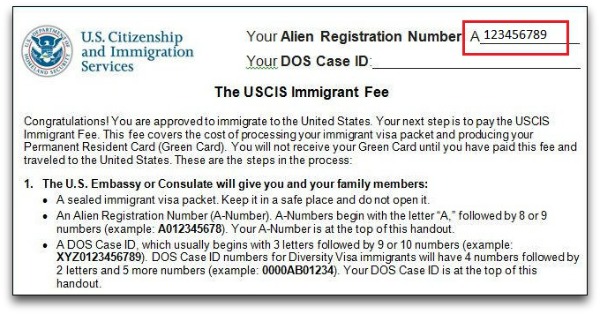
USCIS Immigrant Fee Handout
Your A-Number appears in the upper right corner of the USCIS Immigrant Fee handout. An immigration officer gives applicants this document during consular processing, and it explains how to pay the USCIS Immigrant Fee.
Your USCIS Number and Your A-Number Are the Same Number
The USCIS Number printed on your card is your A-Number. USCIS defines the USCIS Number as a nine-digit number assigned by the Department of Homeland Security and listed on the front of green cards issued after May 10, 2010. Different label, same number.
The number that trips people up is a different one. Your green card also carries a card number on the back, and that number is not your A-Number.
| Number on your card | Is this your A-Number? |
|---|---|
| USCIS# | Yes. Same number, different label. |
| A# | Yes. |
| Card number (back of card, 13 characters) | No. It identifies the card, not you. |
That 13-character code is your green card number. It identifies the specific case that resulted in your green card. It will generally change every time USCIS issues you a new card.
USCIS Forms Require Nine Digits
Write your A-Number as nine digits on USCIS forms. If your number is shorter, add zeros between the letter A and the first digit until you reach nine.
- A12345678 becomes A012345678
- A1234567 becomes A001234567
Older A-Numbers were issued with seven or eight digits, so a shorter number is not a sign that anything is wrong with your record. The form simply expects a fixed length.
An A-Number Identifies You, Not Your Case
An alien registration number is a unique seven-, eight-, or nine-digit number that the Department of Homeland Security assigns to a noncitizen, according to the USCIS definition of the A-Number. USCIS, ICE, and Customs and Border Protection all use it to connect your immigration records across agencies and across time.
You will need your A-Number for four everyday tasks:
- Completing immigration applications, including Form I-130 and Form I-485
- Checking the status of your case with USCIS
- Requesting a copy of your immigration file
- Corresponding with USCIS or the immigration court
Your A-Number stays with you. Generally, USCIS does not issue a new one when you change status, renew a benefit, or receive a new card. In rare cases, people are issued more than one A-Number. The number you used on your first application is typically the number you will use on your last one.
That permanence is what separates it from every other number on your documents. Receipt numbers belong to cases. Your A-Number belongs to you.
You May Not Have an A-Number Yet
The U.S. government creates an A-Number when it grants you an immigration benefit or opens a record on you. Being in the United States does not create one by itself.
You probably have an A-Number if any of these is true:
- You have or have had a green card, even an expired one
- You have been issued a work permit (Employment Authorization Document)
- You received an immigrant visa at a U.S. embassy or consulate
- You were granted DACA, asylum, or refugee status
- You have a pending application to adjust status on Form I-485
- You have been in immigration court
If none of these applies to you, you probably do not have an A-Number, and that is normal. A visitor who has entered the United States many times on a tourist visa does not have one. Neither does a student who never applied for work authorization.
USCIS assigns a number as part of processing when you need one. Form I-485 asks whether you already have an A-Number and, if so, to provide it. Applicants who do not have one generally receive an A-Number during processing, and it then appears on the notices USCIS sends about the case.

Where to Look When Your A-Number Is Missing
If you know you have an A-Number but cannot locate it, work through these five sources in order.
- Check older USCIS notices and approval letters, especially any Form I-797
- Look at copies of applications you previously submitted to USCIS
- Review your passport for an immigrant visa or entry stamps
- Sign in to your USCIS online account
- Request your immigration file through a Freedom of Information Act request
Most people find the number in step one. A single old notice is usually enough, because the number never changed.

Alien Registration Number Questions CitizenPath Customers Ask
The questions below come from the confusion that surrounds the A-Number field on USCIS forms.
One Number Follows You Through Every Application
Your A-Number is the thread connecting every immigration record you will ever have. Once you locate it on any single document, you have it for every form that follows, because it does not change. If you are also working through the separate alien registration requirement, your A-Number is the identifier that ties those records together too.
Finding your A-Number usually means a USCIS application is already sitting in front of you. CitizenPath's USCIS forms services walk you through every question in plain language, check your answers for the mistakes that cause rejections and delays, and give you filing instructions built for your situation. You complete the whole application yourself, at a fraction of what an attorney charges.
Want more immigration tips and how-to information for your family?
Sign up for CitizenPath’s FREE immigration newsletter and
SAVE 10%
on our immigration services