
Employment Authorization Document (EAD): What It Is and How It Works
An employment authorization document lets certain non-citizens work legally in the United States. U.S. Citizenship and Immigration Services (USCIS) issues this card to show employers that you have permission to work for a specific period. Many people call it an EAD, employment authorization card, or work permit. USCIS refers to it internally as Form I-766.
This page focuses on what the employment authorization document is and how it functions. For eligibility rules and detail on the application process, see our Form I-765 Guide →
Key Takeaways
- An employment authorization document (EAD) proves you are allowed to work legally in the United States.
- USCIS issues the EAD, also called a work permit or employment authorization card.
- The EAD does not grant immigration status or travel permission by itself.
- Validity periods and work rights depend on your underlying immigration category.
- Filing and renewing on time helps prevent gaps in employment authorization.
What Is an Employment Authorization Document?
An employment authorization document is a photo ID card issued by USCIS. It proves that you may accept employment in the United States under immigration law.
The card does not grant immigration status. Instead, it confirms that USCIS has authorized you to work based on an existing status or pending application.
You typically need an EAD if:
- Your immigration status does not automatically allow work, or
- You are waiting for USCIS to decide another application, such as a green card.
What an EAD Allows You to Do
An employment authorization document allows you to:
- Work legally for any U.S. employer (unless restricted)
- Complete Form I-9 when starting a job
- Receive a Social Security number if you do not already have one
Most EADs are open market, meaning you can change jobs without asking USCIS for permission. Some categories, however, limit employment to a specific employer or role.

What an EAD Does Not Do
It is easy to confuse an EAD with other immigration benefits. An employment authorization card does not:
- Provide lawful permanent resident status
- Replace a visa or green card
- Allow reentry to the U.S. after travel abroad
If you travel internationally, you may need advance parole or a valid visa. For more details, learn about traveling with an advance parole document →
Who Typically Receives an Employment Authorization Document?
USCIS issues employment authorization documents to many groups, including:
- Adjustment of status applicants
- Asylum applicants and asylees
- Refugees
- Certain students on OPT or STEM OPT
- Temporary protected status (TPS) holders
Each group receives work authorization for a different reason. The underlying eligibility comes from immigration law, not the card itself. For a full list of immigration statuses who can apply, see the Form I-765 eligibility categories →
If you want extra confidence when preparing Form I-765, CitizenPath provides clear instructions written for everyday people. The affordable service checks for mistakes and builds a tailored checklist so you know exactly what to submit. You pay only when you’re satisfied and ready to download your I-765 package.
Employment Authorization Documents Issued as Combo Cards
Some employment authorization documents are issued as combo cards. These cards combine work authorization with advance parole, which allows reentry to the United States after temporary travel abroad.
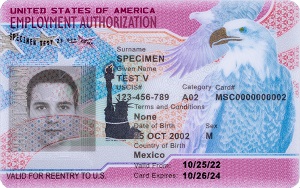
A combo card looks similar to a standard EAD but includes a special endorsement. The front of the card typically states: "Serves as I-512 Advance Parole” or "Valid for reentry to U.S."
If your card includes this language, it means you may use the same card for employment authorization and advance parole travel.
What the Employment Authorization Card Looks Like
The employment authorization card is a secure plastic ID. It includes:
- Alien Registration Number (A-Number)
- Card number
- Category code
- Validity dates
- Advance parole endorsement (if applicable)
Employers use this information to verify work authorization during the hiring process. Your work permit is a valid I-9 document for both identity and employment authorization.

Although previous versions of the card included the beneficiary's signature and fingerprints, the current edition does not.
Employment Authorization Document vs. Green Card
Many people confuse these two documents. They serve very different purposes.
| Employment Authorization Document | Green Card |
|---|---|
| Temporary permission to work | Permanent resident status |
| Expires after a set period | Typically valid for 10 years |
| Does not allow reentry by itself | Allows international travel |
If you are applying for permanent residence, the EAD usually serves as a bridge while USCIS processes your green card. Learn how to get a work permit while waiting for your green card →

Replacing a Lost or Stolen Employment Authorization Document
If your employment authorization document is lost or stolen, you must request a replacement as soon as possible. You generally lack proof of your work authorization without the card.
Replacing an EAD usually requires filing a new Form I-765 and submitting evidence of the loss or theft. Processing times vary, so delays can affect your ability to work.
For step-by-step guidance, see our detailed post on lost EAD replacement →
FAQs About Employment Authorization Documents
Want more immigration tips and how-to information for your family?
Sign up for CitizenPath’s FREE immigration newsletter and
SAVE 10%
on our immigration services