
USCIS Biometrics Appointment: What to Expect and How to Prepare
A USCIS biometrics appointment is a short, routine visit where immigration officials collect your fingerprints, photograph, and signature. USCIS requires the appointment for most immigration applications — including green cards, work permits, and naturalization. This page explains what to expect at your appointment, what to bring, how to reschedule if needed, and what happens next.

Key Takeaways
- A biometrics appointment collects fingerprints, photo, and signature — not an interview.
- USCIS mails you Form I-797C with your date, time, and location.
- For most applications, the biometrics fee is included in your filing fee.
- You may reschedule for good cause, but it will delay your case.
- After your appointment, USCIS will notify you of next steps.
What Is a USCIS Biometrics Appointment?
A USCIS biometrics appointment — sometimes called a biometric screening — is a short, routine visit to a local Application Support Center (ASC) after you file an immigration application. USCIS uses this appointment to collect your fingerprints, photograph, and digital signature. That information confirms your identity and allows the FBI to complete a required background check.
The biometrics appointment is not an interview. In fact, USCIS staff will not ask questions about your application, and you do not need to prepare any answers. Most people are in and out in 15 to 30 minutes.
This appointment is required for most immigration benefits, including green cards, work permits, travel documents, and naturalization. USCIS does not collect blood, urine, or DNA at this appointment.
Your Biometrics Appointment Notice
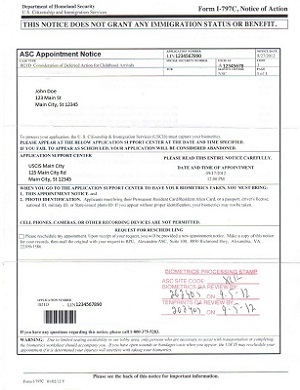
After USCIS receives your application, they will mail you an appointment notice. This document is called an Application Support Center (ASC) Appointment Notice, or Form I-797C. It lists the date, time, and location of your biometric screening. Typically, you should receive it within four to eight weeks of filing.
Above all, read your appointment notice carefully. It will tell you exactly which documents to bring and may include special instructions specific to your case.
Appointment Location
USCIS schedules your biometrics appointment at the ASC closest to your address on file. You should attend at the assigned location. In some cases, applicants can reschedule at a different ASC. However, USCIS makes that decision at its discretion. If you are outside the United States, a U.S. embassy or consulate will collect your biometrics.
To find ASC locations near you, use the USCIS Service and Office Locator →
Biometric Notice Codes
Your ASC Appointment Notice may include a code in the upper right corner of the letter. This code tells you what type of biometrics USCIS needs to collect at your appointment.
| Code | What It Means |
|---|---|
| Code 1 | Fingerprints for all 10 digits only. USCIS forwards these to the FBI for a background check. |
| Code 2 | Photo, signature, and index finger press print. Common for applicants receiving a card such as a green card or EAD. |
| Code 3 | A combination of Codes 1 and 2: photo, signature, index finger press print, and all 10 fingerprints. |
How to Reschedule a Biometrics Appointment
You may reschedule your USCIS biometrics appointment if you have a legitimate reason — what USCIS calls "good cause." However, rescheduling will add weeks or more to your overall processing time. USCIS therefore recommends attending the appointment as originally scheduled whenever possible.
If you miss your appointment without rescheduling or demonstrating good cause, USCIS may consider your application abandoned and deny it. Do not ignore your appointment notice.
What Counts as Good Cause
USCIS defines good cause as a sufficient reason that prevents you from appearing on the scheduled date. According to the USCIS Policy Manual, acceptable reasons include:
- Illness, medical appointment, or hospitalization
- Previously planned travel
- A significant life event such as a wedding, funeral, or graduation
- Inability to arrange transportation to the ASC
- Inability to take leave from work or caregiving responsibilities
- A late-delivered or undelivered appointment notice
How to Reschedule Online
USCIS requires most rescheduling requests to be made online before your scheduled appointment date. To reschedule:
- Create or log in to your USCIS online account
- Select the Biometric Rescheduling option.
- Follow the on-screen instructions to choose a new date, time, and location.
- Select how you want to receive your confirmation (email or SMS).
- Print your new appointment notice and bring it to the ASC.
If you cannot reschedule online, call the USCIS Contact Center at 1-800-375-5283 (TTY 1-800-767-1833) before your scheduled appointment. USCIS no longer accepts written reschedule requests by mail.
Affordable Immigration Support
What to Bring to Your Biometrics Appointment
Bring your ASC Appointment Notice (Form I-797C) and a valid government-issued photo ID. Your appointment notice will specify exactly what is required for your situation — read it carefully and bring everything listed.
Acceptable forms of photo identification typically include:
- Passport or national photo ID issued by your home country
- Permanent resident card (green card)
- Employment authorization document (EAD)
- Driver's license
- State-issued photo ID card
- U.S. military photo ID
What Happens During the Appointment
When you arrive, check in with security and let staff know you are there. Next, staff may give you a short form to complete or a number indicating your place in line. USCIS processes appointments on a first-come, first-served basis among those who share the same scheduled time.
When it is your turn, a staff member will bring you to a biometrics capture station. Using a LiveScan machine, they will digitally record your fingerprints, take your photograph, and capture your signature. Before signing, the screen will display a statement in English or Spanish asking you to confirm the accuracy of your application. If you need this statement in another language, USCIS recommends reviewing the appropriate translation before your appointment.
At the end of your appointment, staff will stamp your appointment notice as proof of attendance. Keep this document. Importantly, it can serve as evidence if USCIS records are ever incomplete.
Additionally, keep these practical tips in mind:
- Do not bring a cell phone, camera, or recording device into the fingerprinting area.
- Food and drinks are not permitted inside.
- There is no formal dress code, but your photo will be taken, so dress accordingly.
- Your attorney or accredited representative does not need to accompany you, even if they filed your application.
The Biometrics Fee
As of April 2024, USCIS eliminated the separate biometric services fee for most applicants. For the majority of immigration applications, the cost of your biometrics appointment is now included in your main filing fee — there is no additional payment required at the ASC.
In rare cases, USCIS may schedule a biometric screening when a fee was not collected at the time of filing. If that applies to you, USCIS will notify you and request payment separately.
Affordable Immigration Support
After Your Biometrics Appointment
Afterward, the next steps depend on your specific application type.
For marriage-based green card cases, an interview at a USCIS field office is typically required. For employment-based cases, USCIS may schedule an interview if questions arise about your application. USCIS will notify you of any upcoming steps by mail or through your online account.
Additionally, you can check the status of your case at any time on the USCIS website using the receipt number from your filing notice.
If you receive a second biometrics screening notice after your first appointment, do not be alarmed. This usually means USCIS could not capture your fingerprints clearly and must retake them. There is no additional fee for a second capture.
Keep in mind that USCIS biometrics remain valid for 15 months. If your application is still pending after that period, USCIS may require you to return for a new biometric screening. This is more common in cases with longer USCIS processing times.
USCIS Biometrics Appointment FAQs
What Customers Say About CitizenPath
Selected reviews from verified customers collected through Reviews.io and Trustpilot.