If you filed Form I-485 to adjust status and need to travel outside the United States, you must plan carefully. Traveling while your green card application is pending carries specific risks. Before you leave the country, it’s important to understand how advance parole for I-485 applicants protects your case.
According to U.S. Citizenship and Immigration Services (USCIS), most adjustment of status applicants who leave the United States without advance parole risk having their case considered abandoned. That means USCIS may deny the green card application. We'll explain when advance parole is required for I-485 applicants, who qualifies for exceptions, and how to travel safely while your case is pending.


What You'll Learn
- Why I-485 Applicants Must Obtain Advance Parole Travel Documentation
- Do All Adjustment of Status Applicants Need Advance Parole?
- Advance Parole Can Protect I-485 Applicants During Emergencies
- How to Apply for Advance Parole While I-485 Is Pending
- Urgent Requests for Advance Parole
- What to Expect When Returning to the United States
- Special Situations That Require Extra Caution
Why I-485 Applicants Must Obtain Advance Parole Travel Documentation
Advance parole is a travel document that lets someone with a pending green card application leave the United States and return without canceling their case.
Advance parole for I-485 applicants protects your pending green card case while you travel temporarily abroad. If you leave without it:
- USCIS will likely deny your I-485 application.
- You lose filing fees.
- You may need to restart the entire process.
- In some cases, you may be stuck abroad.
For most applicants, the risk is not worth it. To learn more about this type of travel document, see our overview of advance parole →
Do All Adjustment of Status Applicants Need Advance Parole?
Most adjustment of status applicants need advance parole before international travel. You generally need advance parole if:
- Your Form I-485 is pending.
- You do not maintain valid H-1B, H-4, L-1, or L-2 status.
- You plan temporary travel outside the United States.
USCIS explains that certain H and L nonimmigrants may reenter using their valid visa instead of advance parole, provided they maintained status and return in the same classification.
However, most applicants do not qualify for this exception. Therefore, advance parole for I-485 applicants becomes necessary before departure.
Advance Parole Can Protect I-485 Applicants During Emergencies
Life doesn’t pause for immigration paperwork.
Family emergencies, funerals, business obligations, or urgent medical situations can arise unexpectedly. Advance parole gives you flexibility. Instead of panicking or making a risky departure decision, you can travel with a layer of protection.
Without it, you’re gambling your pending green card.
How to Apply for Advance Parole While I-485 Is Pending
Adjustment of status applicants may use Form I-131, Application for Travel Document, to request an advance parole travel document.
Many applicants file Form I-131 at the same time as Form I-485. USCIS allows concurrent filing in most family-based and employment-based cases. However, you may still file Form I-131 separately at any time as long as your I-485 is still pending.
USCIS may issue:
- A standalone advance parole document, or
- A combination employment authorization and advance parole card.
Processing times vary by service center. Do not travel until USCIS approves your request.
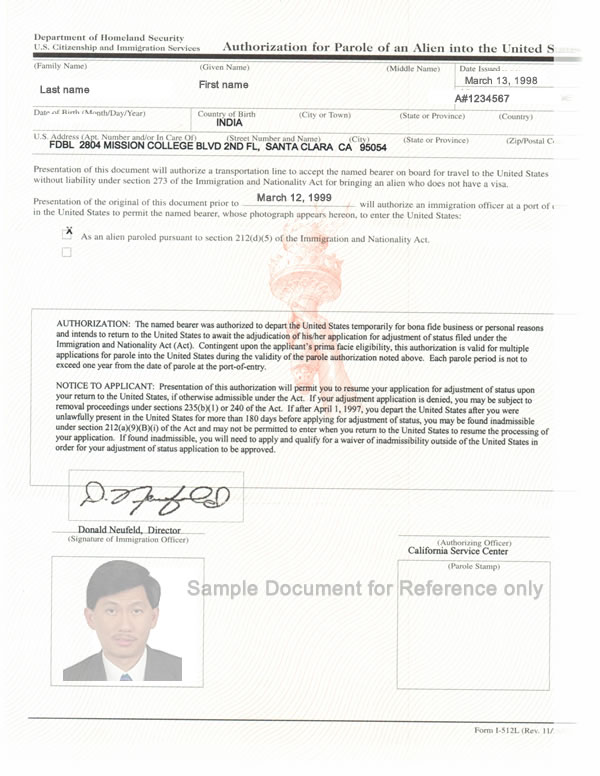
Urgent Requests for Advance Parole for I-485 Applicants
If there is any chance you may need to travel while Form I-485 is pending, apply for advance parole when you file your adjustment application.
Typically, USCIS processing times for Form I-131 exceed six months. That delay can create problems during emergencies. USCIS may expedite advance parole for I-485 applicants in dire situations, but requests are reviewed case by case.
You must provide strong evidence of the emergency, such as medical records or a death certificate. For more detailed guidance, see our page that covers expedited processing for avance parole travel →

What to Expect When Returning to the United States
Advance parole allows you to request entry, but it does not guarantee admission.
U.S. Customs and Border Protection (CBP) determines admissibility at the port of entry. Generally, you should have the following items available:
- Your advance parole document
- Your valid passport
- Your I-485 receipt notice
- Copies of supporting documentation
Special Situations That Require Extra Caution
Most adjustment applicants return without difficulty. However, some applicants face higher risk. You should consult a qualified immigration attorney before travel if you:
- Entered the United States without inspection
- Have a prior removal or deportation order
- Accrued significant unlawful presence
- Have criminal arrests or convictions
Advance parole for I-485 applicants does not waive inadmissibility grounds. CBP still evaluates admissibility independently. If the situations listed above may apply to you, speak to an experienced immigration attorney before attempting to request advance parole.
FAQs About Advance Parole for I-485 Applicants
Prepare Your Adjustment of Status Package with CitizenPath
Travel during adjustment of status requires careful planning. Filing your I-485 package correctly — including your advance parole request — helps protect your green card application from unnecessary delays or denials.
CitizenPath’s attorney-designed preparation service guides you through the entire Adjustment of Status Package, including Form I-131 for advance parole. We help you avoid common mistakes so you can travel with greater confidence once approved.
Move forward with an affordable option for preparing your green card application correctly. Start your Adjustment of Status Package →
Want more immigration tips and how-to information for your family?
Sign up for CitizenPath’s FREE immigration newsletter and
SAVE 10%
on our immigration services