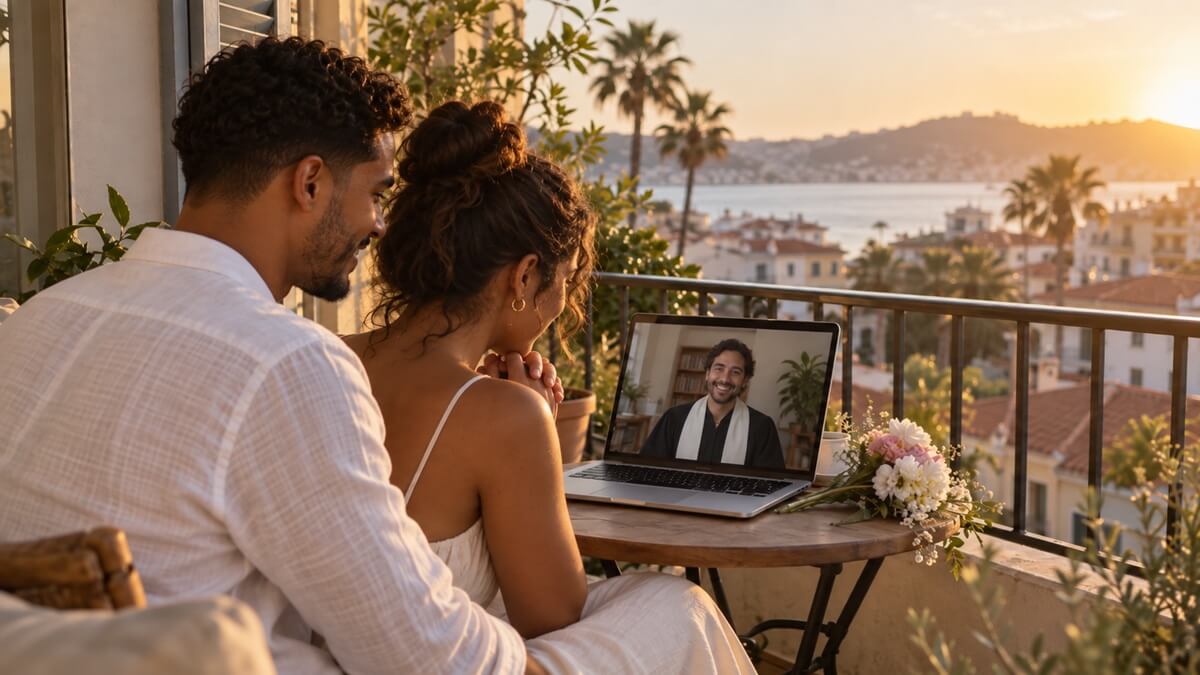
You and your partner live in different countries, and the waiting is the hardest part of it. Getting married online can feel like a way to begin your life together now rather than a year from now.
The question is whether that marriage will hold up when you apply for a green card. Usually it will. U.S. immigration law recognizes most online marriages. Recognition turns on two things, though, and the second one catches people off guard: where the ceremony legally took place, and whether you and your spouse were in the same room while it happened.


What You'll Learn
- When U.S. immigration accepts a marriage performed by video
- The one question that decides what you'll need to prove
- How a proxy marriage differs from a virtual wedding
- What to submit if you married from different countries
- Where couples can legally get married online today
- When a fiancé visa is the better path instead
U.S. Immigration Recognizes an Online Marriage That Is Legal Where It Took Place
An online marriage is a marriage performed remotely by video, where the officiant joins from a different location than the couple. A virtual wedding is the same thing by another name.
U.S. immigration recognizes a marriage that is legal in the jurisdiction where it took place. That jurisdiction is the country or state that issued your marriage certificate. Where you live does not matter, and neither does where you plan to live. If the authority there treated your ceremony as a legal marriage, the U.S. government generally will too. Your marriage certificate is your proof.
Same-sex marriages show how far that rule reaches. A same-sex marriage that is legal where it took place counts for immigration exactly like any other marriage. That holds even when the couple lives somewhere that would not have performed the ceremony. The same sex marriage green card process follows the same requirements as any other spousal case.
There is an exception for marriages that conflict with U.S. law. U.S. law does not recognize polygamous marriages, for example, no matter where they took place. The same goes for a marriage where one party was not free to marry or did not consent to it. CitizenPath's guide to a valid marriage for immigration covers the full set of conditions in plain language.
An Additional Requirement for Couples Not Together at the Ceremony
If you and your spouse were physically together during the ceremony, your marriage certificate is the only proof of validity you submit. If you were apart, two things follow: you must consummate the marriage afterward, and you must submit evidence placing the two of you in the same physical place after the wedding.
This is an important distinction that resolves most of the confusion around online weddings. Immigration law treats a couple sitting side by side on a sofa in Manila, married by an officiant on a laptop screen, very differently from a couple on opposite sides of the world joining the same video call. Both are online marriages. Only the second couple has to prove anything beyond the certificate.
Consummation here means the couple had sexual relations after the ceremony. It cannot have happened before. The practical effect is that the two of you must be physically together at some point after you marry.
| Your situation | What it is | What you must prove |
|---|---|---|
| Both spouses together, officiant joins by video | Virtual marriage | Nothing beyond your marriage certificate |
| Spouses in different places, both join by video | Virtual marriage | That you were together after the ceremony |
| One spouse absent, a stand-in appears in their place | Proxy marriage | That you were together after the ceremony |
One point of confusion we commonly see is couples using "online marriage" and "proxy marriage" as if they mean the same thing. They don't, and the difference changes what a couple has to prove.

A Proxy Marriage Is Not the Same as a Virtual Wedding
A proxy marriage is a ceremony where one spouse is absent and another person stands in for them, with written authority to do so. Nobody is on a video call. Someone is simply representing the missing party.
Proxy marriage is available only in very limited circumstances, generally when one person has a legitimate reason they cannot attend the ceremony in person. Military deployment is the most common example. In Texas, a proxy may be used only when the absent person is a member of the U.S. armed forces stationed in another country and unable to attend the ceremony. California has a similar restriction, allowing proxy marriage when a service member is deployed overseas during a conflict or war. If this applies to you, CitizenPath's guide for a military spouse explains the broader immigration process.
Montana goes furthest. It is the only state that allows a double proxy marriage, where neither spouse appears and stand-ins represent both. At least one party must be a Montana resident or on active duty. You can read Montana's proxy marriage statute for the exact wording.
A handful of other states allow proxy marriages under narrower conditions, and the rules change. Confirm with the county clerk's office where you intend to marry before you plan around it.
For most couples reading this, a proxy marriage isn't the answer. A virtual wedding, where both of you appear by video, is simpler and far more widely available.
Couples Who Married Apart Must Show They Were Together Afterward
When you and your spouse were in different places for the ceremony, your marriage certificate alone won't establish a qualifying marriage. You'll submit evidence that the two of you were physically in the same place after the wedding.
Immigration officials name three kinds of proof:
- A birth certificate of a child born to you both, listing both parents, dated after the ceremony.
- Passport stamps or airline records placing you and your spouse in the same location at the same time after the marriage.
- Evidence of living together, such as a joint lease or signed affidavits from people who know you.
In practice, ordinary travel records do the job. What works is several documents that together place the two of you in one physical location: flight confirmations, hotel or rental receipts, and photographs of you together. Written statements from friends, family, or a religious leader who witnessed both the ceremony and your later visit also help.
From CitizenPath's experience: The consummation requirement catches some couples off guard. They assume the ceremony is sufficient and that a valid certificate is the end of it. If you married from separate countries, plan a visit and keep detailed records of your time together.
This evidence is separate from proving your marriage is genuine, which every couple must do. CitizenPath's guide to bona fide marriage explains the categories of evidence that support a spousal petition.
Utah Lets Couples Get Married Online Without Entering the United States
The state of Utah is the practical answer for couples searching for a way to get married online. Utah County issues fully digital marriage licenses, and its remote ceremony option means neither spouse has to set foot in the United States.
In fact, Utah has no citizenship or residency requirement for a marriage license. In a remote ceremony, it is the officiant's location in Utah that establishes the legal jurisdiction, which is why the couple's own location doesn't disqualify them. Most applicants pay $71.75 in total fees. There is no waiting period, and the license expires 32 days after issue. You can review the requirements on the Utah County marriage license page.
Utah County publishes an important warning worth reading before you plan anything: a marriage solemnized in Utah by online remote appearance may be invalid in the country where the couple lives.
A marriage can satisfy U.S. immigration requirements and still create problems where you actually live — for inheritance, for future travel, or for registering the marriage locally. Check how your own country treats a foreign online marriage before the ceremony, not after.
A Fiancé Visa Is the Better Path When an Online Marriage Won't Work
If your country won't recognize an online marriage, or you can't arrange a visit to consummate one, the K-1 fiancé visa is the alternative. A U.S. citizen files Form I-129F, and the fiancé enters the United States and marries within 90 days of arrival. Details are in CitizenPath's K-1 visa guide.
There is a catch worth knowing before you marry. The K-1 visa is only for people who are not yet married. Once you marry online, that path closes while the marriage stands. A couple who marries by video and then discovers their marriage isn't recognized where they live may have complications if trying to switch to a fiancé visa.
So decide before the ceremony, not after. CitizenPath's comparison of fiancé visa vs spouse visa lays out the cost and timeline differences between the two routes.
Some couples split the difference: they hold a ceremonial online wedding with friends and family, stay legally unmarried, and use the K-1 to marry officially in the United States.
Questions We Hear from CitizenPath Customers About Getting Married Online
These are the questions we often hear from couples working through a spousal petition after an online wedding.
Applying for a Green Card After the Online Marriage
Once your marriage is recognized, the next step is the petition that starts your spouse's green card. Learn how Form I-130 works and what follows it in the marriage green card process. For practical guidance as your case moves along, subscribe to the free CitizenPath newsletter below.
Want more immigration tips and how-to information for your family?
Sign up for CitizenPath’s FREE immigration newsletter and
SAVE 10%
on our immigration services