It isn't uncommon for applicants to realize they need to make a change after submitting a form to U.S. Citizenship and Immigration Services (USCIS). Maybe they spotted a mistake, got married, changed addresses, or received new documents. The question is: how do you update a USCIS application or petition that’s already been filed?
The good news is that there are ways to correct mistakes or provide updates to USCIS without starting over. The right approach depends on the type of update and the stage of your case. This guide focuses on family-based applications and petitions and what you need to do.


When You May Need to Update a USCIS Application or Petition
Even after carefully preparing your forms, you may realize that something has changed or that you left out important information. Understanding the most common situations where you may need to update a USCIS application or petition will help you act quickly and keep your case on track. Examples include but are not limited to:
- You noticed a mistake after mailing your form (wrong date of birth, misspelled name, etc.)
- You need to add evidence (like a marriage certificate or proof of termination of a prior marriage)
- Your mailing address changed after filing
- Family circumstances changed (for example, the birth of a child who should be added as a derivative beneficiary)
- You received new or corrected documents

How to Update a USCIS Application That Is Still Pending
Once an application or petition is filed with USCIS, you cannot simply edit it online or swap out pages. USCIS has specific procedures for correcting or updating information:
Send a Written Request to Amend the Form
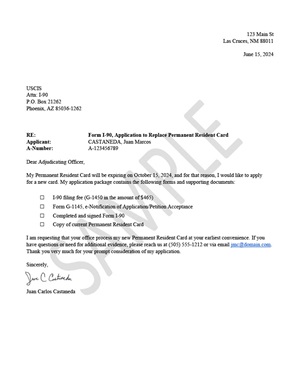
If your case is still pending and you need to correct information, the primary way to address the issue is to send USCIS a written amendment letter. We've provided a sample amendment letter below.
What to include in your letter:
- USCIS receipt number
- Full names of the petitioner and beneficiary
- Alien registration number (if applicable)
- Date of birth (if no A-number provided)
- A clear explanation of what changed or needs correcting by referencing the specific Part and Item number from the form
- Copies of any evidence that supports the update
Where to send it:
Mail your amendment request to the USCIS service center listed on your receipt notice. If you’ve received a transfer notice, use the updated location. Always send by a method with delivery confirmation, and always make a photocopy for your own records.
USCIS Issues an RFE (Request for Evidence)
If USCIS issues you a Request for Evidence, it’s the perfect opportunity to provide missing or corrected information. For example, if you forgot to send proof of a bona fide marriage with your Form I-130, you can provide it with your RFE response.
When responding to an RFE, send a complete response. For example, if they request two pieces of evidence, submit both at the same time in the same response. USCIS generally does not accept piecemeal submissions.
If you need to correct or update something that isn’t specifically mentioned in the RFE, include it in your response packet but keep it separate and clearly labeled from the documents requested in the RFE. This prevents confusion and helps the USCIS officer quickly see that you have fully addressed the RFE while also providing additional updates.
Adding Unsolicited Information
Sometimes you may realize you have additional evidence that may support your request for benefits. You may amend your application package the same way as described in item 1 above.
If you filed online, you can add documents via your myUSCIS account as unsolicited evidence. This isn’t guaranteed to be reviewed the same way as an RFE packet, so upload promptly and keep it concise and clearly labeled.
Updating at the Time of the Interview
For adjustment of status, naturalization, or other cases that require an interview, applicants will have the opportunity to provide any additional information requested and to correct or update answers directly with the USCIS officer during the interview and case review.
Correcting Serious Errors
Sometimes mistakes are too big to fix with a letter. For example:
- Filing the wrong form (e.g., I-130 instead of I-129F)
- Selecting the wrong classification on Form I-130
- Submitting outdated or incomplete versions of forms
Generally, USCIS will reject the package and return it to you. There may be some situations you need to withdraw the petition and refile correctly. While this can feel frustrating, it’s better to fix the problem early than risk a denial after months of waiting.
Updating an Address
If you only need to update your mailing address, use Form AR-11 (Alien’s Change of Address Card) or update it online through your USCIS account. Address updates are legally required within 10 days of moving.
Updating your address ensures USCIS knows where to send notices and helps prevent missed appointments or deadlines.
Updating an Application That Has Already Been Approved
Once USCIS approves your application or petition, you generally can’t go back and amend it. How you make corrections depends on the type of case:
- For family-based petitions (I-130): If approved and forwarded to the National Visa Center (NVC), corrections or updates (such as a petitioner’s change of status from permanent resident to U.S. citizen) should be reported to the NVC.
- For green card applications (I-485): Updates normally happen before approval at the green card interview. Once approved, corrections would involve replacing the green card (for example, if USCIS printed an error).
- For citizenship (N-400): Updates also happen before approval at the naturalization interview. After approval, only typographical or clerical errors on the certificate can be corrected through a separate USCIS request.
- For green cards with errors (I-90): If your permanent resident card contains incorrect information, you must file Form I-90, Application to Replace Permanent Resident Card. If the error was made by USCIS, there is no filing fee.
- For citizenship certificates with errors (N-565): If your Certificate of Naturalization or Certificate of Citizenship has a mistake, you must file Form N-565, Application for Replacement Naturalization/Citizenship Document. As with green cards, no fee is required if the error was caused by USCIS.
Sample Amendment Letter
We have an example amendment letter to help you request a change to a USCIS application or petition.
This sample is provided as a reference only. If you need to amend a pending USCIS application or petition, be sure to update the details so the amendment letter accurately reflects your own situation and the type of correction you are requesting.

Frequently Asked Questions (FAQs)
Smart Software to Make Immigration Easy
Human Support for People Who File
Mistakes and life changes are part of the immigration journey. Fortunately, there are straightforward ways to update a USCIS application without derailing your case. Whether it’s a simple typo, a new address, or updated documents, notifying USCIS promptly is often the best way to keep your case on track.
At CitizenPath, our affordable service guides families through each step of the process and helps you avoid mistakes before filing. Our service includes clear instructions, error-checking, and customer support designed to make immigration paperwork easier.
Ready to file with confidence? Try CitizenPath today >>
Want more immigration tips and how-to information for your family?
Sign up for CitizenPath’s FREE immigration newsletter and
SAVE 10%
on our immigration services