
Employment Verification Letter for Immigration Sponsors (I-864 & I-134)
If you are sponsoring a family member using Form I-864, Affidavit of Support or Form I-134, Declaration of Financial Support, you may need an employment verification letter for immigration to confirm your job and income. This letter helps USCIS determine whether you meet the financial requirements to sponsor an immigrant.
This guide explains when an employment verification letter is required, what USCIS expects to see, and how to write one correctly. If you are the green card applicant, your own letter can also support self-sufficiency, a factor in USCIS's public charge and discretionary review.
Key Takeaways
- An employment verification letter confirms your current job and income for Form I-864 or Form I-134 submissions.
- Green card applicants may also use their own EVL to evidence their self-sufficiency.
- Including it upfront helps confirm other supporting documents to avoid RFEs and delays.
- The letter should be brief, accurate, and employer-issued.
- Combined with other evidence, it strengthens your case as a qualified sponsor.
What Is a USCIS Employment Verification Letter
A USCIS employment verification letter (EVL) is a written statement from an employer confirming a sponsor's job and income for Form I-864 or Form I-134. For immigration purposes, the letter typically verifies:
- Current employment status
- Job title and role
- Start date of employment
- Hours worked per week
- Current income or salary
For Form I-864 sponsors and I-134 supporters, the letter helps USCIS confirm that your current income is stable and ongoing, not just what you earned in the past.

Why USCIS Requests an Employment Verification Letter for Form I-864
USCIS uses Form I-864 to decide whether a sponsor meets the minimum income requirement under federal law. Tax returns show past income, but they do not always prove that you are currently employed or earning the same amount.
An employment verification letter helps USCIS:
- Confirm your current job
- Verify your present income
- Evaluate whether your income is likely to continue
USCIS may request this letter when income is close to the guideline, has changed recently, or appears inconsistent with tax records. However, it's best practice to include the letter with your initial set of I-864 supporting documents →
If you want extra confidence when preparing Form I-864, CitizenPath provides clear instructions written for everyday people. The affordable service checks for mistakes and builds a tailored checklist so you know exactly what to submit. You pay only when you’re satisfied and ready to download your I-864 package.
Employment Verification Letters Also Support I-485 Self-Sufficiency
USCIS evaluates most I-485 applicants under the public charge rule, weighing whether an applicant is likely to depend on government assistance. Self-sufficiency, meaning stable income and employment, is a positive factor USCIS considers.
If you're a green card applicant who is already working lawfully in the U.S., your own letter can demonstrate self-sufficiency by showing steady employment and income. It's not a requirement. It is a positive discretionary factor the a USCIS officer will weight in the totality of the circumstances.
This differs from the sponsor's letter above, which proves the sponsor's income for Form I-864 or I-134. Your own employment verification letter for immigration adds separate evidence to your I-485 filing. Learn more about documenting positive discretionary factors with Form I-485 →
When You Need an Employment Verification Letter
It's best to include an employment verification letter for immigration with your initial submission of evidence to help avoid delays. However, the EVL can be especially helpful in situations such as:
- You recently started a new job
- Your income increased or decreased
- Your tax return does not reflect your current earnings
- USCIS issues a Request for Evidence (RFE)
- You are using current income to qualify, not past income
This letter is supplemental evidence. However, it does not replace tax transcripts, W-2s, or pay stubs.
Who Should Write the EVL
USCIS officers will expect that the letter come from:
- A human resources representative
- A direct supervisor or manager
- A business owner or authorized company officer
The letter should be written on official company letterhead and include contact information.
If you are self-employed, you cannot write a traditional immigration EVL. Instead, you'll need to provide other self employed proof of income →
Required Elements of an I-864 Employment Verification Letter
USCIS expects the letter to be clear, specific, and factual. Include all of the following.
| Element | Why It Matters |
|---|---|
| Employer letterhead | Shows the letter is legitimate |
| Employee full name | Matches the I-864 sponsor |
| Job title | Confirms role and employment type |
| Employment start date | Shows job stability |
| Hours per week | Confirms full-time or part-time status |
| Current salary or hourly wage | Used to assess income eligibility |
| Pay frequency | Clarifies how income is earned |
| Signature and date | Validates authenticity |
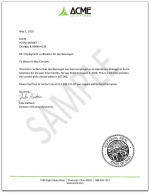
Sample Employment Verification Letter
Use this sample employment verification letter as a general example to be used with Form I-864 or I-134. Every situation is different, so your letter may look slightly different. Keep the letter short and focused.
How to Prepare the Letter (Step by Step)
- Ask HR or your supervisor for the letter
- Confirm all income figures are accurate
- Use company letterhead
- Ensure the letter is signed and dated
- Submit with your I-864 or I-134 supporting documents
Again, include recent pay stubs and tax transcripts whenever possible. The letter is just a form of verification to confirm other primary evidence of your income.
Common Mistakes When Using EVLs
- Missing salary or hours
- Using outdated income amounts
- Submitting unsigned letters
- Submitting generic HR templates
- Not matching income with Form I-864 entries

FAQs About Employment Verification Letters for Immigration Sponsors
Want more immigration tips and how-to information for your family?
Sign up for CitizenPath’s FREE immigration newsletter and
SAVE 10%
on our immigration services